
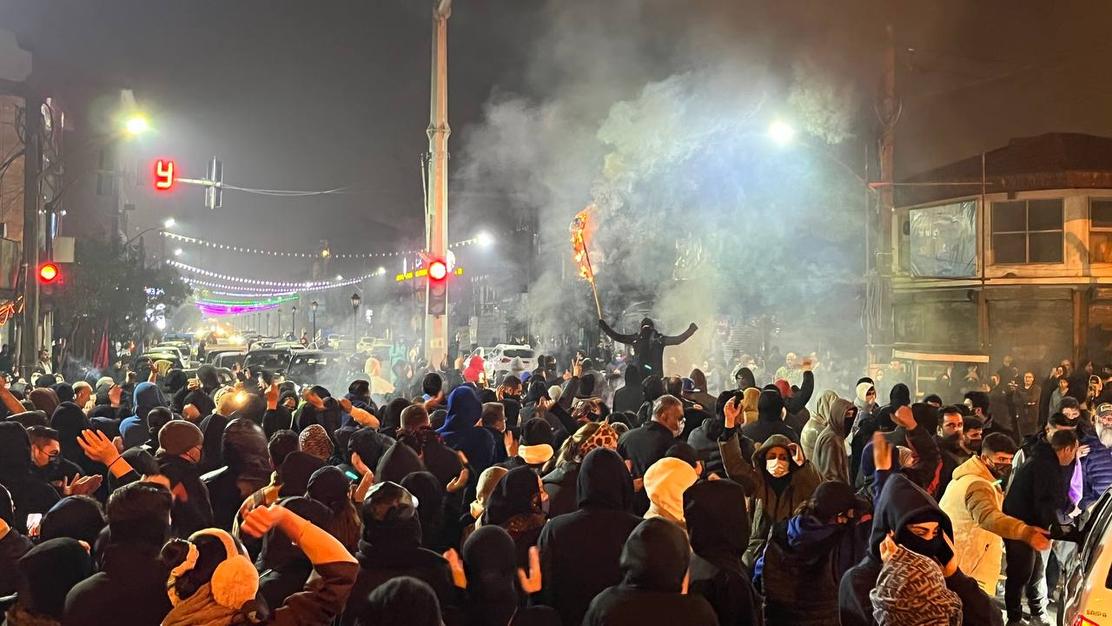


Iran is in flames, with thousands of people protesting on the streets of cities around the country. Ostensibly, it is the drastic devaluation of Iran’s currency (the rial has fallen to a historic low of more than 1 million rials to 1 USD) and high inflation that set off the protests on 28 December 2025, as people are increasingly unable to make ends meet. In view of what is happening in the world, though, with the US intervention in Venezuela and abduction of President Maduro only days earlier, and Iran’s confrontation with Israel and the US just a few months earlier, the economic justification cannot be considered the single or even the primary cause for the unrest.
As expected, the Iranian Supreme Leader and his entourage are blaming the Trump Administration for fanning the flames of discontent. In a defiant response, the Iranian leadership refuses to back down and the confrontation is intensifying, with several fatalities already. President Trump has threatened to intervene if the Iranian authorities start shooting protesters. He may well be bluffing, but who would like to test that, in view of Mr. Maduro’s fate.
This is not the first time that Iranians are protesting against their government. It is not necessarily bad when people demonstrate and demand policy changes from their leadership. We have seen the disruption caused in recent days by farmers protesting loudly and disruptively throughout the EU. It is part of the democratic process, as long as the expression of dissatisfaction and the demands for change remain peaceful overall. In Iran, though, there has been a history of serious grievances and bloody repression, as in September 2022, during the demonstrations for the killing by the Moral Security Police of Mahsa Amini, because she did not wear her hijab properly.
Major demonstrations also erupted in 2009, in protest at the reportedly rigged elections for the Presidency of Iran. In both of these cases, many protesters were reportedly beaten, arrested and tortured, resulting in many casualties, but the protests did not spill all over the entire country and they were eventually quelled by the authorities. The ongoing unrest, however, has spread across all provinces, with a large segment of society participating – merchants, workers and students – even if there is an internet ban meant to hinder the flow of information both inside the country and across its borders.
Since its establishment, through the successful clergy-led revolution against the Shah in 1979, the Islamic Republic has exhibited elements of egalitarian governance but also theocratic rigidity. It has a government elected through universal suffrage, but that government and its President are overseen and can be overruled by the Supreme Leader, who is not popularly elected. The reaction to Iran’s Persian past under the Shah, the grave social inequalities between people and aristocracy, and the interventions of foreign powers and businesses with Iran’s oil in mind, legitimize ,partly at least, the regime. At the same time, the heavy-handed response to demands for easing the strict religious rules on daily life, especially for women, and the inevitable corruption and above-the-law attitude of parts of the regime, have been eroding its legitimacy for decades.
Foreign powers have not stopped interfering, arguably causing the eight-year Iran-Iraq war in the 1980s, imposing severe sanctions on Iran for its nuclear programme, and occasionally bombing installations and people. At the same time, Iran has tried to create regimes or groups friendly towards it within countries that can help undercut its enemies, supplying them with weapons, like Hamas in the Gaza Strip / Occupied Palestinian Territory and Hezbollah in Lebanon. Iran’s projection of strength has been severely curtailed following the US bombing of its nuclear facilities and the tightened sanctions that European countries also supported at the UN Security Council in the fall of 2025.
Is all hope lost, for a peaceful ending of the current protests? Is this going to be the moment when the Islamic Republic will fold and fall, or can it withstand the pressure and plod along once again? Can legitimacy be restored to the regime, its moderate President and/or the theocratic Supreme Leader, or are options like bringing back the former Shah’s son gaining momentum and credibility? Are lofty pronouncements about the 1979 Revolution and fierce verbal attacks on the US and Israel able to reunite the popular base and carry the day once again, or do they sound hollow, with the people asking for external intervention and a new government? What will be the longer-term repercussions for Iran itself, its unity, internal stability and governance, and the entire Middle East region, which does not need another conflagration?
According to the latest figures, close to 60% of Iran’s 85 million population is under 30 years old. They cannot compare the current situation to the one before the Revolution, but they have experienced the shortcomings of, and protests against, the Islamic Republic, including the student protests of July 1999, the Green Movement of 2009, ‘Bloody November’ protests in 2019, and the ‘Woman, Life, Freedom’ movement of 2022. It is difficult to see a peaceful outcome from the youth’s perspective, as they may have become used to violence. Commentators note the changing norms against patriarchy, especially among the youth, as an outcome of the recent successive protests and a positive step for cultural change, even if political change has remained elusive, as of now.
What is for sure, as in the case of the latest US intervention in Venezuela, is that no outsider would be eager to impose regime change with boots on the ground in Iran. Perhaps a transitional arrangement could be made, as in Venezuela, with the current Iranian government, possibly without the oversight of the Supreme Leader, who could be assassinated or abducted. Would that open the way to Western-style democracy and would that allow the economy to come out of its impasse, especially if international sanctions are also lifted? Would such an intervention be accepted by Russia and China, the powerful allies of Iran through the BRICS and the Shanghai Cooperation Organization, which are also among its main trading partners?
Until all these possibilities play out and some clarity gets established, the organized international community – which means not only or primarily the US, or any other individual country or small group of countries – cannot be sitting on the sidelines, watching as the situation in Iran deteriorates and the fatalities increase. The UN system, especially human rights instances, as well as the Secretary-General and/or other senior envoy(s) should hold fact-finding and mediation visits, in an effort to at least minimize the casualties. A credible monitoring process can reduce deaths and mass arrests, creating breathing space for the protesters, facilitating dialogue rather than allowing violence to escalate. As for the leadership of Iran, they should think twice whether force and repression can “put the genie back in the bottle” or substantive reforms are urgently needed in the country’s economy and politics, so that there is a better future for all Iranians, especially the youth. Finally, from Iranian Supreme Leader Khamenei to President Trump and Prime Minister Netanyahu, all leaders concerned should realize the importance of a peaceful resolution of the situation, rather than claiming divine right or playing God and using brutal force to shape things to their liking.
References
1. https://www.iranintl.com/en/202601061682
2. https://carnegieendowment.org/sada/2023/09/mahsa-aminis-legacy-a-new-movement-for-iranian-women
3. https://www.bbc.com/news/articles/c23r4yeyxl9o
4. https://www.euronews.com/2026/01/09/irans–khamenei–accuses–protesters–of–pleasing–trump–amid–ongoing–unrest
5. https://www.aljazeera.com/news/2026/1/5/a–timeline–of–protests–in–iran–after–the-1979-islamic–revolution

Dr Georgios Kostakos is Co-founder and Executive Director of the Brussels-based Foundation for Global Governance and Sustainability (FOGGS). He has been a UN staff member, including with the Executive Office of the UN Secretary-General, the High-level Panel on Global Sustainability, the UN Framework Convention on Climate Change (UNFCCC), and field missions for political affairs and human rights. He has also worked with think tanks, academic institutions and as a consultant on global governance and sustainability, peace and resilience.

Manan Shah, based in Ahmedabad, India, currently serves as Operations Lead at FOGGS – Foundation for Global Governance and Sustainability. His role centers on research, IT systems, social media outreach, and analysis of governance and global sustainability issues. Manan is passionate about community outreach, climate action, and promoting the Sustainable Development Goals, and continues to engage in projects that bridge technology, advocacy, and positive social change.