

Earlier this month, the U.S. lifted sanctions that were imposed on interim President Delcy Rodriguez since 2018. This means she will be able to engage directly with U.S. financial entities and multilateral organizations such as the IMF. This paves the way for increased foreign investment in the country and the renegotiation of its external debt. This development comes less than a month after the reestablishment of diplomatic relations between the U.S. and Venezuela, which occurred on March 5. In this author’s view, these recent changes directed at the Venezuelan government are not related to country’s direction under Delcy, but rather to the international situation in which the U.S. finds itself. Under conditions of assured international supremacy, the U.S. would be harsher against Venezuela.
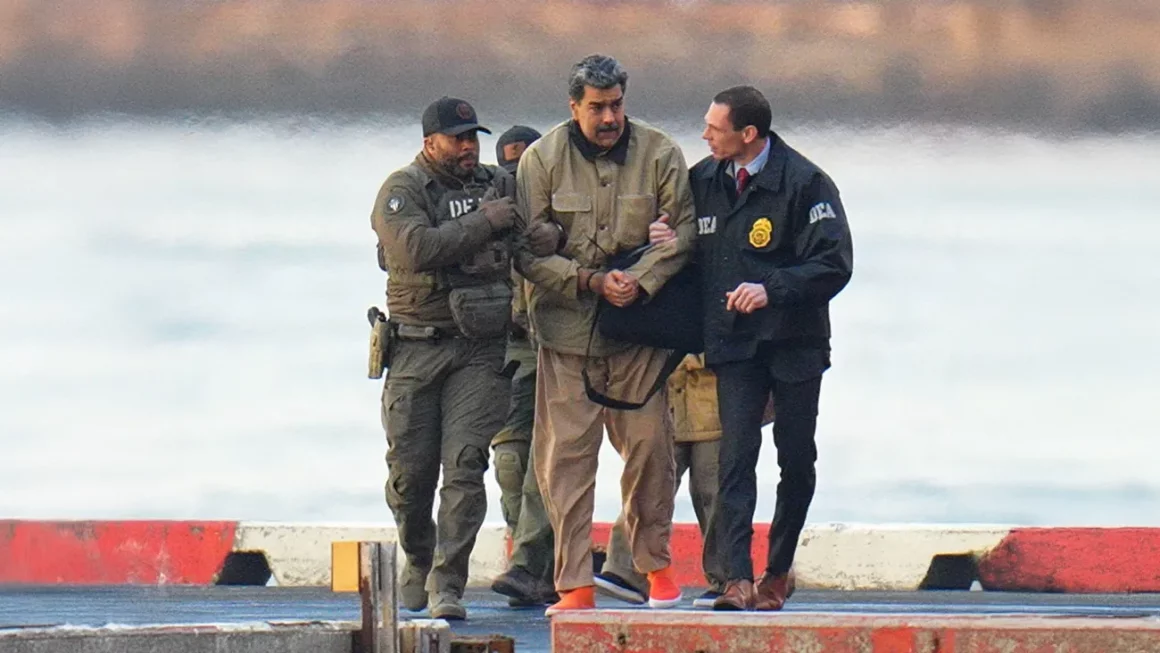
Let’s go back to early this year when U.S. made an assault on Venezuela, which included the kidnapping of President Nicolás Maduro and the deaths of at least 80 individuals. This was another episode of the increasing pressure against the Andean nation over the past year, intensifying accusations against Maduro and seizing oil tankers in acts reminiscent of piracy. By US standards, such action does not constitute change, but it is just another episode in the long history of U.S. interference in Venezuela and Latin America. A historical analysis reveals that the motivation is not concern for democracy or human rights, but rather access to oil and natural resources.
As early as the beginning of the 20th century, the United States, the United Kingdom, Germany, and Italy carried out a naval blockade of Venezuela after its president, Cipriano Castro, refused to pay a debt to the U.S. and compensate Europeans for damages suffered during a civil war in the country. Venezuela then pledged 30% of the customs revenue from its main ports to settle the debt. The U.S. continued to send warships to Caribbean countries to take over customs and pay foreign debts to itself and its allies; this practice became known as the Roosevelt Corollary, which was the main instrument of U.S. domination over Latin America and the Caribbean at the time.
From the 1940s onward, with oil becoming the primary export commodity, U.S. oil companies turned their attention to the country. The growing U.S. interest in Venezuela led to the country plunging into a military dictatorship by the end of the 1940s, aligning with U.S. imperialistic desires. In the 1950s, the United States decorated the regime’s main dictator, Pérez Jiménez, with the Legion of Merit. This is the highest U.S. distinction possible to be awarded to a foreigner. The award was a recognition of Jiménez’s efforts to ensure the presence of U.S. oil companies in the exploitation of Venezuelan oil.
After this dictatorship, the Punto Fijo Pact was established, in which initially three parties (later two: AD and COPEI, formally centre-left and centre-right, but both elitist) alternated in power, excluding the communist party (the most active party against the dictatorship, which was proscribed during the Puntofijista period). This arrangement lasted until Chávez’s election in 1998 and was praised by U.S. academics as an example of institutional stability, while commercial relations with the U.S. prospered. The biggest crisis of the Punto Fijo Pact occurred during the Caracazo in 1989, protests against President Carlos Andrés Pérez’s (AD) fiscal austerity programs. In this context, Chávez attempted to seize power by force in 1992, was arrested, released, and finally elected in 1998, favoured by a weakening of the Puntofijista parties after their adherence to the neoliberal agenda.
Chávez’s election was significant for two main reasons: first, it ended the rotation of power between AD and COPEI in government; second, it prioritized popular agendas and socialist reforms as policy objectives. His government amended the hydrocarbon law and placed PDVSA in control of oil extraction operations in the country in 2000. From then on, he was portrayed as a dictator by the Western media. In 2002, Chávez faced a coup supported by the U.S., which installed Pedro Carmona, president of the country’s main industrial federation (FEDECAMARAS), in his place. Carmona intended to govern through decree-laws. This “democratic” form of governance pleased the U.S., which was one of the few countries to recognize Carmona as president. Chávez, who had been imprisoned, was freed by popular pressure and restored to power just days after the coup.
Since then, Venezuela has experienced constant pressure from the U.S. During this period, the Chavista government used high oil prices to fund a series of social programs. Many of these programs are still in effect today. Examples include popular housing programs, subsidized food, and the issuance of documents for the entire population. However, these programs entered a crisis with a 70% drop in crude oil prices around 2014, plunging the country into a severe crisis marked by inflation and the deterioration of social projects.
Nevertheless, it was under the Maduro government that pressure intensified even further, with the initiation of sanctions against Venezuela under the pretext of defending human rights. These sanctions excluded PDVSA from the international financial system. They also seized the company’s assets in the U.S., where PDVSA owns a chain of gas stations and an oil refinery under the CITGO brand. All of this occurred under the auspices of the self-proclaimed president Juan Guaidó, who was supported by the U.S. The UN itself recognized that the sanctions only worsened the human rights situation in the country, as the funding for social, health, and public education programs depended on oil, whose production declined from 2017 due to the blockade.
It is important to mention that Venezuelan oil is “heavy,” difficult to refine, and its machinery requires constant maintenance. The United States, thanks to many years of partnership, possesses the necessary technology for this. The technological blockade of PDVSA triggered an economic domino effect that exponentially worsened the lives of the population and deepened the crisis resulting from the fall in commodity prices.
Regarding the claim of “Maduro’s dictatorship,” history demonstrates that this holds little importance for the U.S., which supported the Venezuelan military dictatorship and was a partner of an oligarchic government until the late 1990s. The true problem of Chavismo for the U.S. is that it drastically reduced its influence over Venezuela’s oil, even though the U.S. remains the country’s main trading partner. In the domestic front the Bolivarian Revolution nationalized important infrastructure such as electricity that angered the elites as they lost their power and leverage. Furthermore, Chavismo opened unprecedented channels for political participation in Venezuelan history. It also conducted a series of constituent assemblies that expanded the rights of the population.
The Venezuelan opposition frequently featured in mainstream media is far from democratic. We are referring to far-right politicians prepared to cede the nation’s resources to the United States and other foreign powers. Maria Corina Machado, recently awarded the Nobel Prize, belongs to a traditional Venezuelan elite family. Her father was a steel industry magnate, an uncle was influential in FEDECAMARAS and owned the country’s primary electricity company, which was privatized in 2007 by Chávez. Juan Guaidó reportedly has ties to criminal cartels responsible for drug trafficking and extortion. Evidently, as if all violations related to coup plotting and treason were not sufficient grounds for his criminal designation.
The attacks against Venezuela throughout the twentieth century and the attempted kidnapping of Maduro must be analysed in this context: it is about securing resources that the U.S. considered its own. This is why Trump stated about the oil: “It was the biggest theft in the history of America. Nobody ever stole our property like they did.” Additionally, the United States made it clear in its 2025 National Security Strategy (NSS) document that it aims to “Restore American energy dominance” in oil, gas, coal, and nuclear energy.
With Maduro’s forced invasion and withdrawal, the government maintained its structure, PSUV governors reiterated the normal continuity of their mandates, and Chavismo is still the largest political force in the country and remains in power. At the federal level, Vice President Delcy Rodríguez assumed the role of interim president, despite Trump’s bravado that the U.S. is governing the country. Meanwhile, Trump praised Rodríguez’s “very strong leadership.” Rodríguez announced what she calls a “partial reform” of the country’s hydrocarbon legislation, as U.S. oil companies push for easier access to Venezuela’s oil. So far, Delcy waves to the U.S. and waves back to the people, advocating fearless diplomacy with Maduro’s kidnappers. There are internal restrictions in the political structure to reverse the reforms that Chavismo brought to the country.
U.S. actions under Trump are an adaptation of the Roosevelt corollary, where they would pressure and invade Latin American countries to build their financial hegemony. However, in the early 20th century, the United States was building its hegemonic power. Nowadays, such an endeavour is a sign of its declining international power and position, despite still being the strongest power in the Latin American subcontinent by a large margin, while China is closing the gap at a global level. In International Relations, sovereignty means the ability to autonomously resolve issues of internal and external policy. The U.S. interferes in Venezuela both internally (supporting self-proclaimed presidents) and externally (sanctioning and kidnapping legitimate presidents).
However, the situation in the Strait of Hormuz compelled the United States to ease its pressure on one of its primary energy exporting partners. Venezuela is characterized by significant historical pressures, in which both sanctions and elite actions contribute substantially to the destabilization of its political system. In my view, the lifting of sanctions constitutes a strategic retreat by the U.S. concerning the country. Concurrently, the opening of the market and the pursuit of investments may also constitute a similar strategic concession from Chavismo. On several occasions, the acting president has sought to attract further investments to the country. The U.S. and Israeli confrontation with Iran makes it evident that Trump’s assertions warrant scepticism. We do not know his actual opinion on Delcy or Venezuela.
The easing of sanctions does not change the bigger picture. The U.S. will increase dominance over Latin America. This runs counter to the U.S. loss of global hegemony to China, which makes the imperialist reaffirmation over our subcontinent a matter of survival for the United States and its economic model, whether or not Trump assures things are going well. The invasion of Venezuela and the blockade against Cuba shows that they are attacking the least aligned first, but this does not mean that restraint regarding U.S. political positions is synonymous with peace and tranquillity for the people. History has already proven to us that this is not enough.
2 comments
28 April, 2026 @ 17:53 Carlos Eduardo Ferrero
Whatever Chavismo achieved and whatever self-interest motivated the US to act as it has for the last hundred years, the poor in Venezuela has remained as poor as in 1905. It has been relegated to read all this pseudointellectual vomit. All this mineral wealth has only benefited those in power in Miraflores and/or those pulling the strings from abroad.
18 April, 2026 @ 10:17 Kindery
Thanks for being a bright light in sometimes dark and difficult times for everyone