

Introduction: The Crisis of Conscience in Our Time
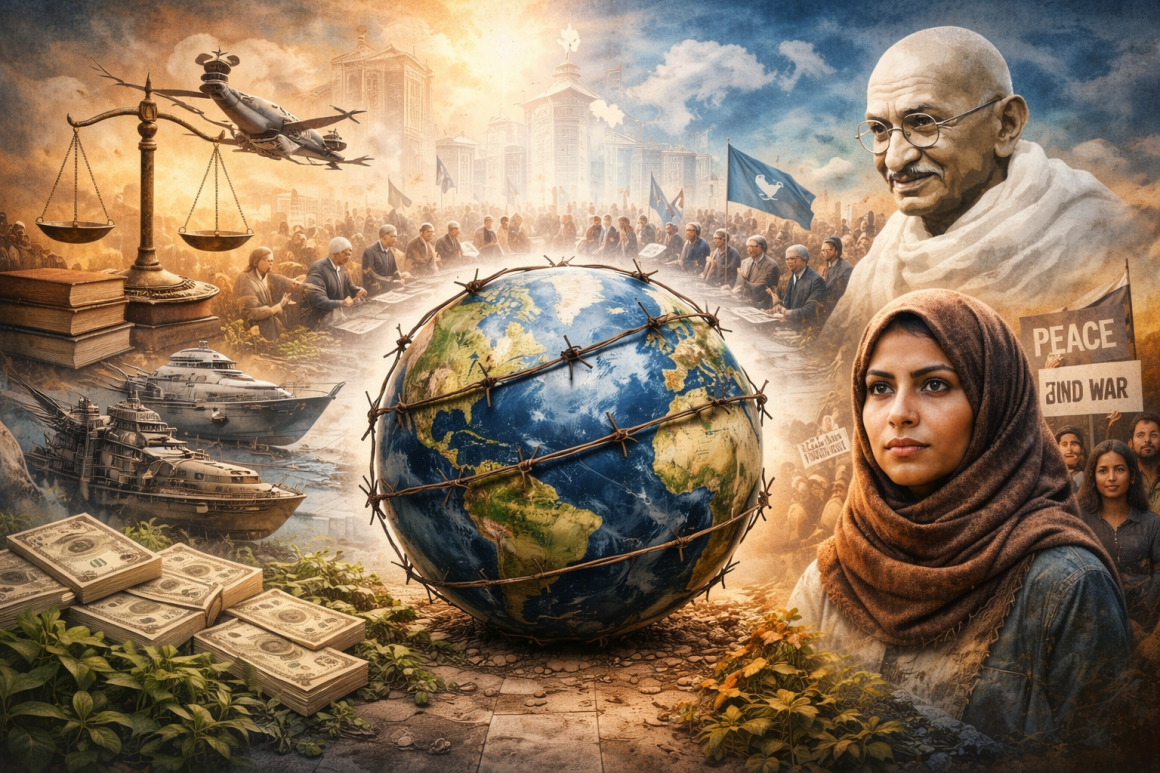
Within the international system, violence is no longer treated as an unwelcome departure from what is normal. Rather, it is increasingly being used as one of its organising principles. War is standardised as policy, civilian suffering is reframed as collateral damage and instead of being an ethical priority, peace is reduced to a temporary agreement for managing conflict. The humanitarian disaster resulting from the numerous conflicts currently playing out across the globe – most evidently in Gaza – harbours a deeper moral failure: the erosion of conscience in global political life.
Despite the existence of international humanitarian law, the ongoing efforts of global institutions and the proliferation of diplomatic speak, civilian populations continue to be systematically deprived of food, water, shelter and medical care. When such deprivation continues despite repeated international warnings, it demands that we question what has become of peace as an ethical concept. And, more urgently, what it means to exercise moral agency in a world where suffering is administered rather than prevented.
The International Court of Justice’s provisional measures in South Africa v. Israel to protect civilians and ensure humanitarian access in Gaza affirm that legal obligations are not absent but merely selectively applied and implemented. This goes to show that while international law can be acknowledged in principle, it can simultaneously remain materially unenforced in practice. Under such conditions, law becomes just a symbol, a procedure that inevitably fails those it is meant to protect. This is the real risk of law without conscience.
The Erosion of Peace and the Selective Application of Law
Current practice in peace negotiations often involves simply putting a band-aid on the problem: with ceasefires that do not address the underlying issues, negotiations that ultimately do not include accountability, and diplomatic processes that marginalise the voices of those most affected by violence. United Nations agencies have repeatedly asserted that occupying forces have very clear obligations under international humanitarian law, including ensuring access to food, health care and essential services (UN Office for the Coordination of Humanitarian Affairs – Occupied Palestinian Territory). However, these obligations are routinely seen as less important than securing geopolitical connections, veto power, and pursuing more strategic interests.
This selective application of international law raises some fundamental questions. For one, if legal norms are enforced only when politically convenient, can they still be considered to apply to all human beings, regardless of race, nationality, culture or religion? For another, if a commitment to human dignity is not at the heart of civilian protection and, instead, the focus is on alliances, then how are distinctions drawn between lives deemed worthy of mourning and protection and those treated as expendable within global political calculations?
Such contradictions erode confidence in institutions, and in fact, in the very idea of a rules-based international order. For many in the Global South, this only reinforces long-standing concerns that international law functions within a hierarchy that is shaped by colonial legacies and current power imbalances, and not by shared ethical commitments.
Greed Without Conscience: The Military-Industrial Complex
Armed conflict continues unabated, even with overwhelming proof of its devastating human cost. Present-day warfare can only be understood by getting to grips with the political economy that sustains it: a vast military-industrial complex. This system thrives on prolonged instability, hooking arms manufacturers, private defence contractors, surveillance and technology firms, reconstruction corporations, and financial institutions in with structural investment.
Within this ecosystem, destruction and rebuilding are reduced to a profit cycle with sequential stages: humanitarian crises generate contracts; devastated cities become sites for reconstruction markets; and security narratives justify continuous militarisation. In such a system, if peace threatens the economic interests of those in power, it risks being unfavourable.
This reality prompts an unavoidable ethical question: Can peace genuinely emerge from a global economy that materially benefits from war? And further, what does “security” mean when insecurity itself becomes profitable?
The normalisation of this system extends beyond battlefields to research funding, media narratives and policy frameworks. It subtly biases militarised solutions while marginalising justice-orientated and nonviolent alternatives.
Gandhian Ethics: Truth, Nonviolence and the Moral Foundations of Peace
Against this backdrop, Gandhian ethics usually synonymous with moral idealism, instead offer a rigorous framework for political responsibility. Gandhi’s principles of Ahimsa (nonviolence) and Satyagraha (truth-force) insist that means and ends are inseparable, and that violence – regardless of justification – ultimately corrodes both society and the moral legitimacy of power (Gandhi Foundation).
For Gandhi, peace could never be reduced merely to the absence of conflict; it also requires justice, dignity and the welfare of all (Sarvodaya) to be present. He warned that political systems driven by greed and domination inevitably dehumanise both the oppressed and the oppressor (M. K. Gandhi, Global Peace in the Twenty-First Century).
Nonviolence, following this stream of thought, is then not passive resignation but rather, it is active moral resistance – which calls for courage, collective action and a refusal to mirror the violence of unjust systems. This challenges current political realism and asks whether we have dismissed ethical resistance as impractical precisely because it threatens entrenched structures of power.
Feminist Peace Theory: Gender, Structural Violence and Human Security
Feminist peace theory offers a deeper ethical understanding of both violence and peace, arguing that it is too simple a conclusion to say that war is sustained through weapons. Feminist scholars assert that conflict is also kept alive through social structures that normalise inequality, exploit unpaid care labour, and turn a blind eye to women’s suffering. Traditional security models centre purely on state sovereignty and military power, and therefore, often fail to take into account the lived experience of violence faced by women and marginalised communities on a daily basis (Women’s International League for Peace and Freedom).
The uncomfortable truth is that harm persists long after the end of a war or conflict. What is left is structural violence – the poverty, displacement, food insecurity and gender-based harm. Peace cannot be achieved without addressing this. Furthermore, empirical research consistently shows that peace processes make more of an impact when women are invited to participate meaningfully and when social justice is treated as integral to security, not secondary to it (UN Women – Peace and Security).
Gandhi’s political practice anticipated this insight by recognising women as central moral agents in struggles for justice. Feminist peace theory echoes this view, asking: What kind of peace excludes those who sustain life during war? And how credible is peace when care, survival and social reproduction are treated as peripheral concerns?
Global South Perspectives: Decolonising Peace and Reclaiming Dignity
Particularly for developing countries, “peace” mostly brings to mind a scenario of enforced stability under hugely unequal global agreements, rather than freedom, dignity or justice. To address this imbalance, Global South perspectives challenge dominant assumptions about peace and security by exposing the lived histories of colonialism, economic extraction and imposed political order.
Present-day wars are not based on new points of conflict but on a continuous theme of structural domination that has been entrenched for centuries – now mediated through arms trade, debt regimes, geopolitical alliances and development conditionalities. Genuine peace will not be achieved through humanitarian interventions that are detached from accountability and self-determination; this would just be a reproduction of paternalistic control.
Can peace imposed from above avoid replicating the very hierarchies that generated conflict? The view of Global South scholars is that peace must undoubtedly be participatory, community-rooted and grounded in economic justice and political voice. Peace merely negotiated among powerful actors is not true peace at all.
Towards an Integrated Framework of Conscience-Based Peace
Gandhian ethics, feminist peace theory and Global South perspectives share an important insight: peace is fundamentally a moral and relational project. It cannot be engineered solely through institutions nor enforced through military dominance. It can only come to light through justice, inclusion, ethical restraint and accountability.
This integrated framework demands intellectual honesty and moral courage. It requires the acknowledgment that remaining neutral when faced with structural injustice makes one complicit, not impartial; that development without dignity does nothing to curb violence; and that peace without conscience boils down to an insincere performance rather than being transformative, as it should be.
The central question, therefore, is not whether alternatives exist, but whether global institutions and societies are willing to centre them in policy, practice and pedagogy.
Conclusion: Conscience as Political Responsibility
The present global crisis is fundamentally about conscience, not territory, sovereignty or strategic power. It is about whether humanity can still have empathy for the suffering of others, or whether efficiency, profit and geopolitical advantage have fully displaced moral responsibility.
To reclaim peace, conscience must be made a public part of political responsibility. We need educators to teach about peace as lived ethical practice, policymakers to see human security as more important than militarised dominance, and citizens to not accept suffering as the norm.
Only time will tell whether this era will be remembered as one in which humanity surrendered peace to power – or as one in which conscience re-entered history as a transformative force.
What is certain, is that the answer will not lie in declarations alone, but in the ethical choices we make – individually and collectively, persistently and courageously.

Sudha Sreenivasa Reddy is Director of the Eco Foundation for Sustainable Alternatives, consultant with the Centre for Child and the Law, National Law School of India University, Bengaluru, India and a former Advisor to FOGGS. Her work spans peacebuilding, climate justice, gender justice, food and nutrition security, and the inclusion of vulnerable persons with disabilities, religious minorities, and sexual minorities, across practice, advocacy, policy, research, and community engagement. Drawing on Gandhian ethics, feminist peace theory, and Global South perspectives, her writing engages conscience, justice, and lived realities. She is a recipient of the Maya Koene International Peace Award (2025).