
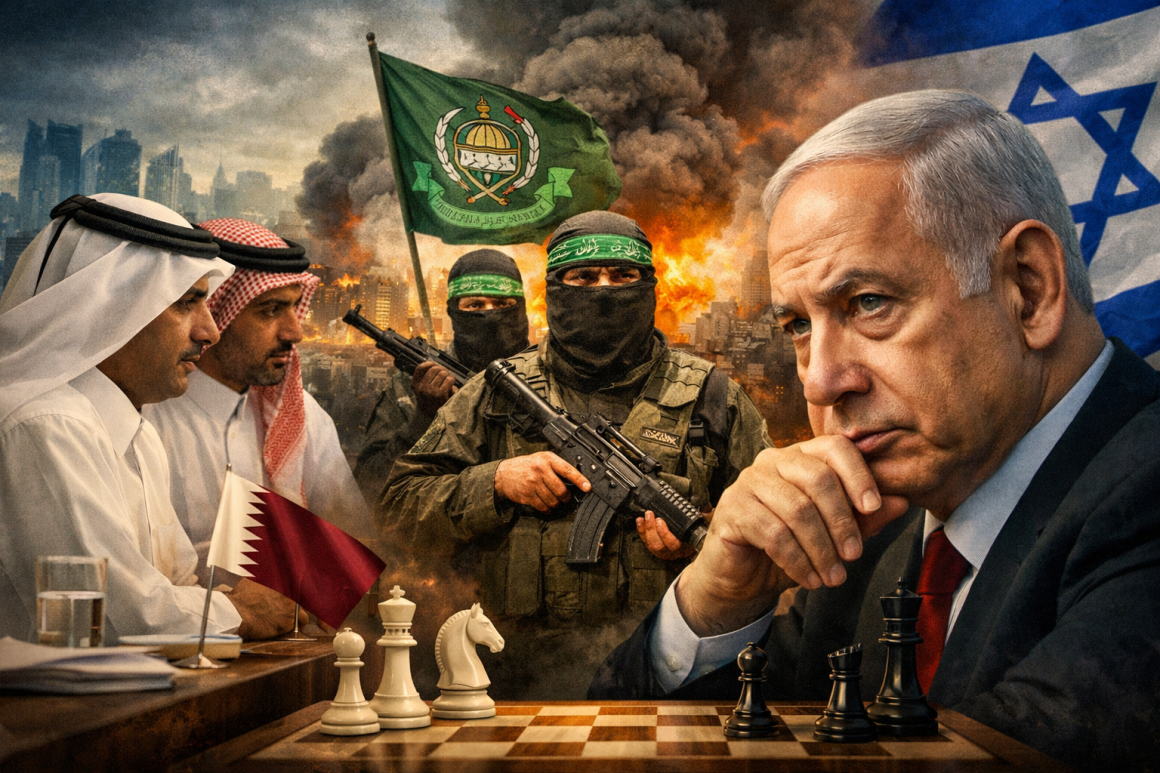

Qatar is a tiny state with a population of around three million, in which foreign nationals make up approximately 76 percent of the population, while migrant workers account for nearly 90 percent of the labour force. And yet it plays an outsized role in global and regional politics, ranging from major investments in Africa and Türkiye, to mediation in Middle Eastern conflicts. Its close ties with the United States, its formal designation as a “Major Non-NATO Ally” and its simultaneous support for the Muslim Brotherhood and Hamas have made Qatar a paradoxical actor. The question is whether Qatar truly serves as a neutral mediator or whether it has been drawn into Netanyahu’s long-standing strategy of controlling and radicalizing the Palestinian issue.
Qatar: A small country with big ambitions
Qatar is an unusual case in that with its tiny native population and vast wealth, it has positioned itself as a key mediator and sometimes even an intervener in global and regional disputes. So too it has projected influence far beyond the Gulf by, for example, investing in Africa, Türkiye and beyond, whilst also competing with Middle Eastern powers such as Saudi Arabia and the UAE, and politically with Egypt across the Arab and African world.
International reports show that Qatar has invested billions of dollars in projects across Africa and Asia through its sovereign wealth fund. Data from the World Economic Forum (WEF) indicates that in Africa alone, Qatari commitments have reached more than $7 billion , which is a remarkable figure for such a small state, and a clear indicator of its geopolitical ambitions.
The 2017 blockade and Gulf rivalries
Saudi Arabia, the United Arab Emirates, Bahrain and Egypt subjected Qatar to a blockade in 2017, with Israel tacitly supporting the move. The quartet issued a list of thirteen demands, ranging from ending support for the Muslim Brotherhood and Hamas to curbing ties with Iran, that closely echoed U.S. Secretary of State Mike Pompeo’s later on Iran. Several noted that the Saudi-UAE-Bahraini-Egyptian blockade of Qatar in 2017 was driven in part by a struggle over influence within Palestinian politics, particularly Doha’s ties to Hamas and the Muslim Brotherhood, with Riyadh and Abu Dhabi seeking to curtail Qatar’s role.
Open and hidden ties with Israel.
In the 1990s, Qatar even built sports facilities in Israel. Trade between Doha and Tel Aviv reportedly reached $1.5 billion before 2023. Qatar established official trade ties with Israel in 1996, becoming the first Gulf state to do so, before closing the office in 2000. Between 2000 and 2009, relations between Qatar and Israel were largely conducted in silence and through discreet channels. Occasional covert contacts and rare high-level visits—most notably the exceptional trip of Shimon Peres to Doha in 2007—were among the few visible signs of engagement. Nevertheless, until 2009, Qatar maintained a firm public stance on the Gaza issue, keeping official relations formally closed while any interaction with Israel continued quietly behind the scenes. It ties again in 2009 after the Gaza War, but by the following year, it proposed reopening trade on the condition that Israel allow construction materials into Gaza. Israel refused. Yet, paradoxically, Israeli authorities approved the entry of hundreds of . A widely cited, though disputed, quote attributed to Netanyahu at a 2019 Likud meeting claimed, “Whoever wants to prevent a Palestinian state must support Hamas… This is part of our strategy: to separate Palestinians in Gaza from those in the West Bank.” In 2024, Netanyahu admitted to fabricating the quote to Time magazine. Still, Netanyahu has never defined Qatar as an enemy. Meanwhile, allegations of Qatari influence, echoing the “Qatargate” scandal in Europe, have persisted in Israel. Figures such as Mohammed al-Emadi, Doha’s envoy, and Shlomi Fogel, an Israeli tycoon, have been accused of facilitating strategies that radicalized Hamas in ways that served Israel’s long-term goals. Such activity is in addition to the financial activities of Netanyahu’s
Hamas and Netanyahu’s rise
During the election contest between Shimon Peres and Netanyahu, Hamas attacks inside Israel sparked public outrage and directly contributed to Netanyahu’s victory. Peres reportedly warned Yasser Arafat that unless he used his influence to restrain Hamas, Netanyahu would win. Strikingly, those attacks abruptly stopped right after the elections.
Controlling the conflict Through Hamas
The point is not to question Hamas’s legitimacy, but to show how Netanyahu has consistently exploited it. His strategy has been to . By portraying Hamas as the embodiment of all Palestinians, he could justify collective punishment and delegitimize Palestinian national aspirations. Qatar, knowingly or not, became the financier of this strategy. As Donald Trump would later reiterate in various contexts, Qatari money and Palestinian blood paid the costs of these policies, not American money. Meanwhile, the UAE and Egypt pursued their track by backing Mohammed Dahlan, in coordination with Israel, as a counterweight to , which has sidelined figures such as Marwan Barghouti, who might have posed a genuine challenge to both Hamas and Abbas.
However, this does not mean that one should completely dismiss the idea of Hamas serving as a scapegoat for Israel. Rather, Israel uses this umbrella to avoid resolving the Palestinian issue and to demonize it. Israel and Netanyahu use this conceptualization to try to legitimize the massacres.
Syria, Qatar and Hamas’s exodus
After the Syrian uprising, Hamas’s ties with Iran deteriorated. Syria cracked down on Palestinian factions, and Khaled Meshaal broke with Assad. Doha became the new home of Hamas’s political bureau. Yet this relocation weakened
The end of Qatari mediation?
With Israel’s ongoing assaults on Gaza, Lebanon and Syria, Netanyahu seems intent on completing his project: dismantling Hamas entirely. In this scenario, Qatar’s role as mediator becomes irrelevant. Netanyahu has never truly believed in negotiations, and Hamas leaders meeting in Doha found themselves targeted without warning from regional states and/or even the U.S., which maintains a massive base at Al Udeid.
The message was clear:
- Israel considers itself above international law and Arab states dare not coordinate against it.
- Iran’s proxies are collapsing, making ties with Israel no longer a choice, but an obligation for Arab regimes. As Qatar itself once admitted, “Israel is a reality.”
- By striking Hamas leaders in Doha, Israel spared Qatar the embarrassment of formally expelling them while still forcing them out.
Türkiye in the crosshairs
The likely next step is Hamas relocating to Türkiye, giving Israel a pretext to pressure or even strike within NATO territory, a risky escalation. While some argue NATO’s Article 5 would deter such action, Qatar’s case shows that even close partners are not immune. Ziyad al-Nakhalah, leader of Islamic Jihad, was already pressured by Israel and the U.S. to move from Beirut to Cairo; similar tactics could be tested against Ankara. Türkiye and Qatar continue to function as strategic partners—particularly in trade and on the Syrian file—while maintaining only limited and cautious coordination with Damascus. Meanwhile, Israel has courted Druze and Kurdish groups to counter Turkish influence, but Ankara continues doing business with Israel, and yet, as Qatar learned, cooperation does not guarantee protection.
Conclusion: Israel’s greater project
With Iran weakened and the regional balance shifting, Israel has emerged as the primary beneficiary of the current realignment, alongside the UAE and Saudi Arabia. Iraq and Lebanon are no longer arenas of Iranian influence alone, but sites of a broader power struggle. In this context, Hamas has functioned less as an independent actor than as a tool, within Israel’s long-term strategy, to manage, rather than to resolve, the Palestinian question and as such, mediation efforts, including Qatar’s role, were never designed to produce a political settlement, but to contain the conflict. As regional actors increasingly accept Israel as an unavoidable reality, the prospect of a genuine two-state solution to the Israel-Palestine question continues to recede.