
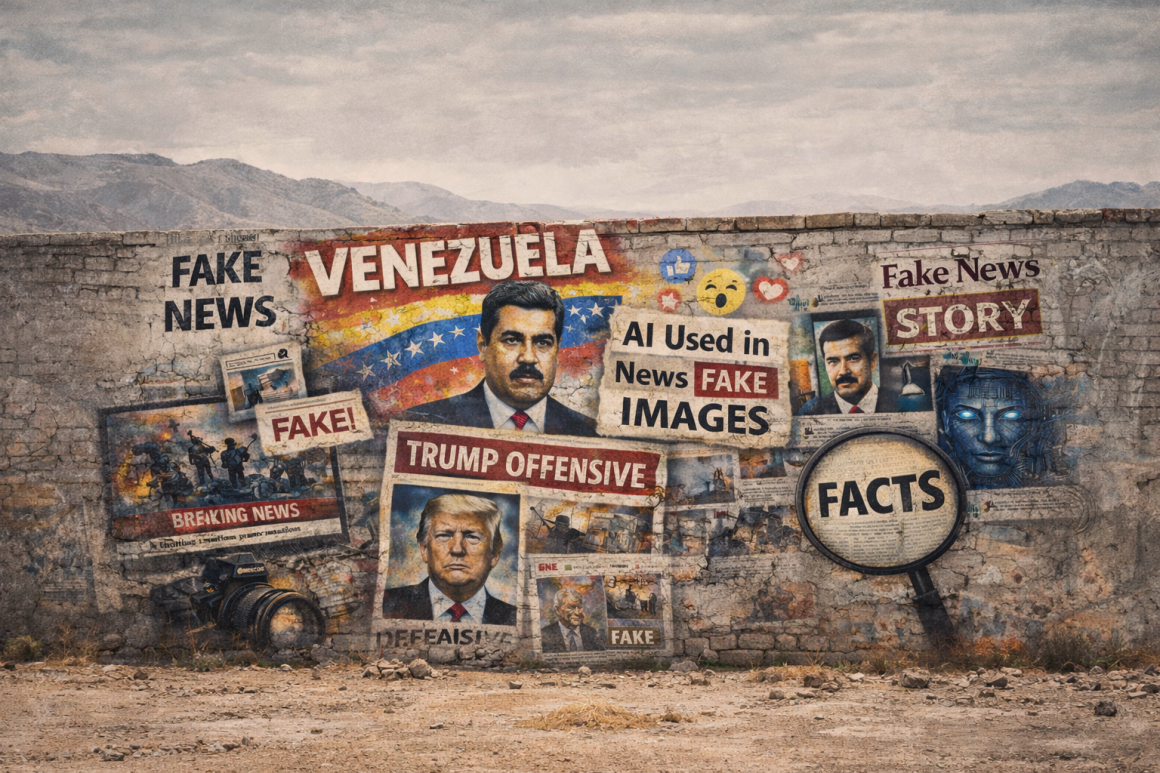
The military operation staged by the United States under the government of Donald Trump against Venezuela on 3 January 2026 is not only a warning for international law and multilateral institutions. It is a litmus test for journalism, revealing whether the press acts as an objective witness in moments of escalation or becomes part of the spectacle it is meant to scrutinize.
The operation places international journalism before a familiar dilemma. News organizations must decide whether to follow the accelerated and polarized flow of content through social media or to reaffirm their commitment to the public interest, human rights, international law and global stability. In situations of geopolitical escalation, this choice is not merely technical or professional. It shapes public understanding of and response to what is happening, legitimizes or not narratives of force, and influences how conflicts are perceived and remembered.
The information environment surrounding the Venezuelan case was quickly marked by belligerent rhetoric, interventionist framing and morally reductive narratives. Complex political and humanitarian dynamics were reduced to binary oppositions structured around winners and losers. Attempts at contextualization were frequently dismissed as complicity, while emotionally charged content circulated widely across digital platforms. In this setting, disinformation operated not simply as factual error, but as a political and communication strategy embedded in platform logics.
The dimension of this crisis became particularly visible in the days following reports surrounding the removal of Nicolás Maduro from power on 3 January 2026. The sudden nature of the U.S. operation left many newsrooms facing information gaps, limited access to verified sources and a shortage of reliable imagery. In this vacuum, social media content rapidly gained prominence. A video allegedly showing young people being tortured by the Maduro regime circulated widely. It was later identified by the fact-checking organization Chequeado as footage taken from the Venezuelan fiction film Simón (2023), a Netflix production presented as being based on real events.
It is a matter of record that the Maduro government is under investigation by the International Criminal Court for crimes against humanity. At the same time, the circulation of the video detached from its original context illustrates how factual elements can be mobilized in misleading ways.
In the days that followed, multiple deepfakes spread online, including AI-generated images of Maduro in prison and videos falsely presented as the release of political prisoners. These materials circulated alongside legitimate reporting, blurring the boundaries between verification and manipulation. Some international media outlets reinforced this confusion by prioritizing narratives of “arrest” rather than clearly identifying the event as a military offensive carried out by a foreign power on the territory of a sovereign state. This imbalance was intensified by the unequal structure of global media ecosystems, largely dominated by outlets based in the United States.
The Venezuelan case therefore exposes a crisis of mediation between objective reality and public perception. In the field of journalism and communication, mediation does not mean a neutral approach aimed at reconciling opposing political actors, as it does in conflict resolution practices. Mediation refers instead to the processes through which information is selected, contextualized and made meaningful in the public sphere. It is the condition that enables a lucid public opinion, capable of understanding events in their complexity, contradictions and unfolding consequences. Through mediation, journalism connects facts to historical trajectories, legal frameworks and humanitarian implications, allowing society to assess not only what is happening, but what is at stake and what may follow.
When mediation collapses, public debate is reduced to fleeting reactions, emotional alignment and performative positioning. Journalism ceases to function as a space of interpretation and becomes a vector of amplification. In such contexts, the distinction between reporting on a conflict and participating in its symbolic escalation becomes increasingly blurred.
This dynamic can be critically examined through the lens of peace journalism. When Johan Galtung first formulated the concept in the 1970s, one of his central concerns was that the way conflicts were covered by the media tended to generate a climate of cheerleading among audiences. Wars and political crises were framed as contests, inviting the public to take sides rather than to understand structural causes and human consequences. What becomes striking in the current context is a historical inversion of this concern. Journalism no longer only fosters a climate of cheerleading among audiences; it increasingly assumes that role itself.
In the coverage of the U.S. military offensive in Venezuela, this shift became visible when journalistic mediation gave way to performative alignment. Instead of prioritizing verification, contextual explanation and restraint, parts of the press reproduced polarized narratives, amplified emotionally charged content and aligned themselves with power-driven framings. The space for complexity, uncertainty and critical distance narrowed significantly.
Peace journalism does not propose silence, moral relativism or the suspension of critique. It calls for rigorous verification, careful language and a refusal to transform suffering into spectacle. It emphasizes the human consequences of political and military decisions, the asymmetries of power involved and the legal frameworks governing international action. In the Venezuelan case, this would have required clearer differentiation between military intervention and judicial processes, sustained attention to civilian vulnerability and greater transparency regarding informational sources.
Never has it been more necessary to draw on the insights developed by Johan Galtung. The lenses of peace journalism, with their emphasis on structural context, power asymmetries and human consequences, do not offer ready-made solutions, but they can reduce the pressure placed on journalism in moments of escalation. By reaffirming mediation, proportionality and analytical distance, peace journalism helps transform this test from a demand for alignment into a responsibility for interpretation.
The implications extend beyond this specific episode. When violations of international legal principles are presented as inevitable or necessary, and when human rights are selectively invoked to justify the use of force, a discourse of exception becomes normalized. In this context, this inversion becomes evident, as journalism no longer only fosters a climate of cheerleading among audiences but increasingly assumes that role itself. This is not a matter of defending governments or regimes, but of defending the rules and institutions designed to limit arbitrariness and violence in international relations.
At the same time, journalism itself operates under sustained pressure. Political leaders frequently delegitimize the professional press, portraying verification and contextualization as obstacles rather than safeguards. When news organizations adopt the logics of social media without ethical restraint, they reinforce these critiques and weaken their own credibility. Defending journalism therefore requires the conscious refusal of practices that collapse mediation into mere amplification.
Covering Venezuela and U.S. foreign policy demands more than access to official statements. It requires historical knowledge, attention to power asymmetries and sensitivity to humanitarian consequences. Above all, it requires acknowledging that journalism is not external to the conflicts it covers. Through framing, selection and language, it actively shapes the public sphere in which political decisions are debated and contested.
In a context of global instability, journalism is not merely an observer of events. It is part of the process through which meaning, legitimacy and accountability are produced. The U.S. military offensive in Venezuela exposes this responsibility with particular clarity. As a test of journalism, it reveals whether the press can sustain its mediating role or whether it will surrender that role to the dynamics of cheerleading, polarization and disinformation.

Cilene Victor is a journalist who has worked as special correspondent in several countries, covering humanitarian issues and Climate Conferences in Paris, Marrakesh, Bonn, and Katowice. She is a Full Professor in the Graduate Programs in Communication and Religious Studies at the Methodist University of São Paulo, where she leads the research group Humanitarian Journalism and Media Interventions (HumanizaCom). She also teaches at FGV LAW, is a co-founder of the Global South Perspectives Network and a researcher with the Climate Disaster Project (University of Victoria, Canada).