
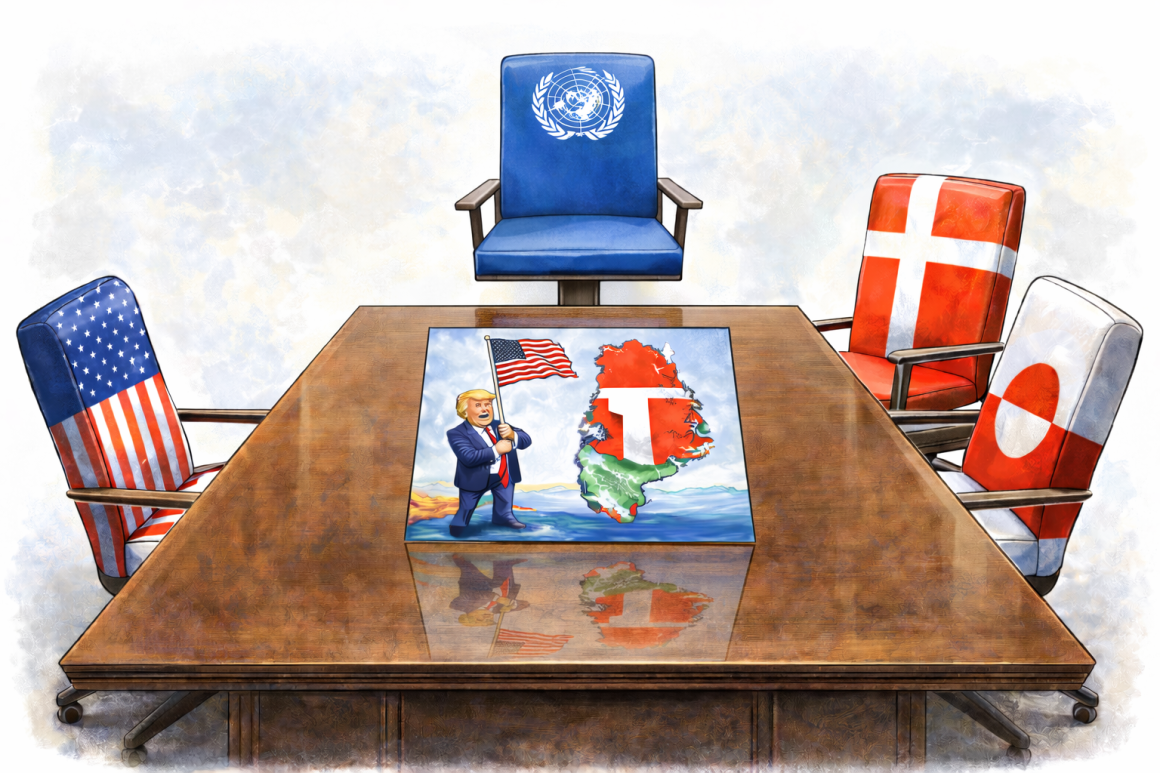



Greenland has long been perceived as a remote and tranquil part of the world, a place where geopolitical storms rarely reach. Yet recent years have shown that even the Arctic’s icy expanses are not insulated from the ambitions of powerful states. The public assertions by President Trump that to the US should acquire Greenland, even through the use of force if the offer to buy it was not accepted, have transformed what once seemed an improbable scenario into a genuine test of transatlantic cooperation but also of the international community’s conflict prevention capability.
Increasing verbal tensions and the threat of tariffs and counter-tariffs does not mean that conflict is imminent; given recent actions, though, this cannot be summarily dismissed. Tensions and threats do underscore how quickly strategic competition, resource interests, and political rhetoric can converge into a situation requiring careful management. This article argues that the Greenland case offers an opportunity to operationalize the preventive logic embedded in the UN Charter before tensions harden into open confrontation. It seeks to provide normative and practical guidance, first to the parties directly involved but also to the broader international community – as this is a potential threat to international peace and security, on how existing Charter mechanisms can be mobilized proactively towards conflict prevention.
Chapter VI and the Security Council: A Preventive Resolution Without US or Danish Sponsorship
The UN Charter’s Chapter VI, devoted to the peaceful settlement of disputes, was designed precisely for situations like this: moments when tensions are rising, but before any confrontation occurs. The United States’ public interest in acquiring Greenland, combined with statements implying the possibility of force, creates a situation that other states may reasonably view as a potential threat to international peace and security.
A Security Council resolution under Chapter VI could help defuse the situation by:
- Affirming the principles of territorial integrity and self determination
- Recognizing Greenland’s unique constitutional status within the Kingdom of Denmark
- Encouraging all states to refrain from coercive measures
- Calling for dialogue among Denmark, Greenland’s Self Government, and interested states
- Requesting periodic reporting on developments affecting Arctic stability.
Because both the United States and Denmark currently sit on the Security Council, they would normally be central to any such initiative that would involve others. However, being the parties directly involved in the dispute, the US and Denmark, or one of them, may have no interest in bringing the issue to the Council, or may want to influence the Council’s decision unilaterally, if the issue makes it to the agenda of the Council. To avert that, Article 27(3) of the Charter provides a way out by stipulating that parties to a dispute must abstain from voting on decisions under Chapter VI. This means that other Council members, could draft and pass a resolution even if Washington and Copenhagen chose not to support it. This provision is not merely procedural. It constitutes a Charter-embedded means of bypassing veto paralysis in situations where preventive diplomacy is most needed, allowing other Council members to act collectively to uphold international law even when major powers are directly involved.
Such a resolution would not be punitive. It would instead create a diplomatic framework that reduces the risk of unilateral action and reinforces the idea that Greenland’s future must be determined peacefully and in accordance with international law.
Article 99: The Secretary General’s EarlyWarning Authority
The Secretary General possesses a rarely used but powerful tool under Article 99 of the UN Charter: the ability to bring to the Security Council’s attention any matter that “in his opinion may threaten the maintenance of international peace and security.” Far from being a passive early-warning device, Article 99 enables the Secretary-General to act as an agent of preventive diplomacy, signaling that emerging tensions merit collective attention before they escalate into formal disputes.
The combination of strategic competition in the Arctic, the United States’ public statements about purchasing Greenland, and rhetoric suggesting the possibility of force, could reasonably be interpreted as a situation requiring early attention. The Secretary General could therefore:
- Formally notify the Security Council of emerging risks
- Request consultations on Arctic stability
- Propose a factfinding mission to Greenland, Denmark and the US, as well as to Russia and China if deemed necessary
- Offer good offices to facilitate dialogue among relevant parties.
An Article 99 intervention would not imply that conflict is expected. Rather, it would signal that the UN is fulfilling its preventive mandate. It would also ensure that Greenland’s own authorities, which have repeatedly emphasized that the island is not for sale, are included in discussions that affect their future.
Preventive Deployment: A Confidence Building Measure for the Arctic?
The idea of deploying an international presence to Greenland may seem unconventional, particularly in light of sensitivities around sovereignty and militarization. Preventive deployment, though, is a UN innovaton successfully tested in the past, and is designed as a confidence-building rather than an interventionist tool. The UN Preventive Deployment Force (UNPROFOR) in the then “former Yugoslav Republic of Macedonia” (now North Macedonia) in the 1990s demonstrated that a small, neutral presence can help stabilize a region before tensions escalate.In the context of Greenland, preventive deployment could serve as a confidencebuilding measure that reassures all parties that the Arctic remains a cooperative and demilitarized space. Any such mission would require the consent of Denmark and Greenland’s SelfGovernment, and its mandate would need to be strictly nonmilitary.
A preventive mission could include:
- Environmental and climate security monitoring teams
- Maritime safety observers;
- Liaison officers facilitating communication among Arctic states
- Experts supporting indigenous rights and community resilience.
Such a presence would help ensure transparency, reduce mistrust, and provide neutral reporting on developments that could affect regional stability.
Why Greenland Matters: A Strategic and Symbolic Test Case
The United States’ public interest in purchasing Greenland, and the rhetoric suggesting that force might be considered if the island were not for sale, has elevated the frozen island from a quiet corner of the world to a symbol of the challenges facing the international system. The situation touches on several core principles:
- Territorial integrity
- Self determination
- Non use of force
- Respect for indigenous governance
- Peaceful settlement of disputes
If the international community cannot act preventively in a case like Greenland, where tensions are still manageable and where the legal principles are clear, its ability to prevent conflict elsewhere will be called into question. The case of Greenland offers a rare opportunity, particularly for powerful Western actors, to demonstrate that the UN Charter can be used proactively rather than reactively. Employing preventive tools before positions harden would reaffirm multilateralism not as a post-crisis management framework, but as a living system for avoiding crises altogether.

Dr Georgios Kostakos is Co-founder and Executive Director of the Brussels-based Foundation for Global Governance and Sustainability (FOGGS). He has been a UN staff member, including with the Executive Office of the UN Secretary-General, the High-level Panel on Global Sustainability, the UN Framework Convention on Climate Change (UNFCCC), and field missions for political affairs and human rights. He has also worked with think tanks, academic institutions and as a consultant on global governance and sustainability, peace and resilience.

Daryl Swanepoel is the Chief Executive Officer of the Inclusive Society Institute and a Research Fellow at the School of Public Leadership, Stellenbosch University. He is a leading voice on global governance reform. With a career spanning politics, business, and academia, he has served as a parliamentarian, strategist, and educator. His current focus includes work on reimagining the UN system, challenging entrenched power dynamics, and driving inclusive solutions.

Cilene Victor is a journalist who has worked as special correspondent in several countries, covering humanitarian issues and Climate Conferences in Paris, Marrakesh, Bonn, and Katowice. She is a Full Professor in the Graduate Programs in Communication and Religious Studies at the Methodist University of São Paulo, where she leads the research group Humanitarian Journalism and Media Interventions (HumanizaCom). She also teaches at FGV LAW, is a co-founder of the Global South Perspectives Network and a researcher with the Climate Disaster Project (University of Victoria, Canada).