
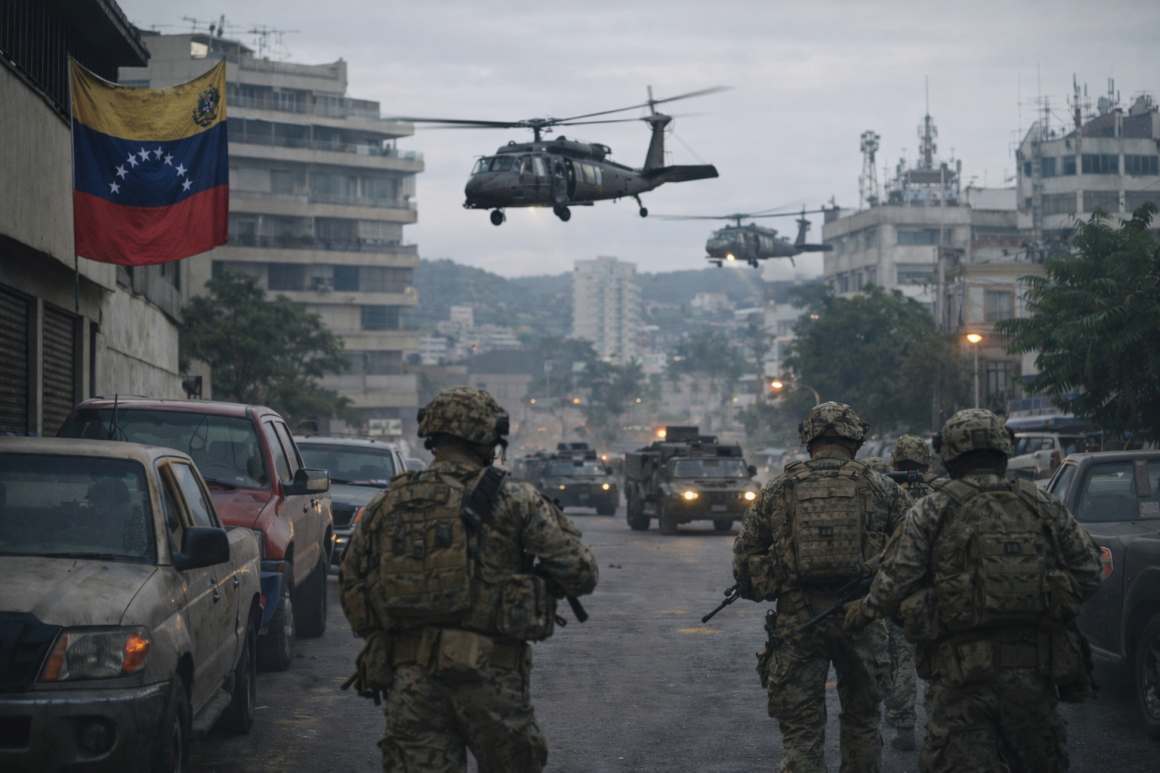

The United States’ military operation against Venezuela in early January has been widely reported as a dramatic episode: air strikes on strategic sites, the forced removal of President Nicolás Maduro and the most direct US intervention in Latin America in decades. But to treat the event as merely another regional crisis is to fundamentally misunderstand its significance. What occurred in Venezuela was not simply a breach of sovereignty. It was a rupture in the normative architecture that has underpinned the international system since 1945.
At its core, the intervention represents a decisive break with the idea that force, if used at all, must be constrained by multilateral legality, proportionality and collective consent. The prohibition on the use of force enshrined in the UN Charter has always been imperfectly observed. Yet its persistence as a norm mattered precisely because it created thresholds, political, legal and moral, that restrained escalation. The Venezuela operation crossed those thresholds with striking ease.
What is particularly unsettling is not only the act itself, but the manner in which it was justified and received. The intervention was framed through elastic rationales: security threats, criminality, instability. These justifications were sufficiently vague to be universally applicable, and therefore dangerously portable. When the use of force is normalised through such broad pretences, legality ceases to be a guardrail and becomes an inconvenience.
This points to a deeper structural shift, one in which violence in the contemporary international system is no longer only episodic or exceptional, in that it has become systemic. It is embedded in institutional incentives, strategic doctrines and political narratives that reward decisiveness over deliberation and dominance over restraint. The Venezuela episode fits into a wider pattern in which incremental norm violations accumulate until the boundary between rule and exception dissolves.
It has been said that violence behaves like a contagion. Once exposure occurs without consequence, replication follows. The international system currently lacks robust mechanisms that are capable of interrupting this contagion, precisely because the institutions that were designed to mediate conflict and enforce norms, most notably the United Nations, are increasingly unable to act as effective circuit breakers. The paralysis is not simply bureaucratic, it is political and it is rooted in power asymmetries within the UN system that allows some actors to act with impunity, while others are disciplined for far lesser transgressions.
This asymmetry serves to erodes legitimacy. Moreover, when the architects and custodians of the multilateral order disregard the very rules they helped to develop, the system’s moral authority collapses inward. The response to the US’s Venezuela invasion illustrated this collapse quite starkly, in that the condemnation and celebration of the military intervention coexisted in equal measure, thereby revealing how fractured the global conscience really is. The possibility of the international community developing a unified normative response, one that reinforces restraint and collective security, is indeed becoming increasingly remote.
For the Global South, the implications of the US’s actions are profound. Many states have long navigated global power through a combination of strategies such as hedging, alignment and/or normative deference, and/or by relying on international law and multilateralism as buffers against coercion. The Venezuela intervention suggests, however, that these buffers are thinning, because whilst formal sovereignty may remain intact, practical sovereignty, that is insulation from unilateral force, is eroding.
This reality forces a reassessment of strategic posture; passive reliance on existing frameworks is no longer sufficient. What is required is agency, collective, deliberate and forward-looking. Three broad pathways have emerged in recent Global South deliberations.
The first is collective de-risking. This does not imply isolation or withdrawal, but rather a conscious effort to reduce over-dependence on any single power centre, such as expanding South-South trade, deepening regional cooperation and diversifying diplomatic partnerships, not as ideological gestures, but as resilience strategies. By acting collectively, rather than individually, Global South states can turn their combined exposure into coercive leverage.
The second pathway is institutional renewal. Multilateralism is not obsolete, but it is unquestionably strained. Reform is no longer a matter of representation alone, it is about authority, enforcement and credibility and therefore constitutions must be capable of constraining power, not merely accommodating it. To achieve this renewal will require new coalitions, a rebalanced of the decision-making structures and a sustained engagement that will have to hold beyond moments of crisis.
The third pathway is to reclaim the narrative. And perhaps the most insidious consequence of systemic violence is the erosion of empathy, which has led to civilian suffering, displacement and disruption being absorbed as mere background noise in the global discourse. In this regard the Global South has a critical role to play in re-centring humanitarian norms and moral responsibility, which should go beyond the mere rhetorical posturing about restoring the idea that restraint, cooperation and human dignity must remain foundational to global order.
The regional and global ripple effects of the Venezuela intervention are already visible, where, for example, in Latin America, fears of precedent and contagion are reshaping diplomacy, migration patterns and security calculations. And across regions, the US’s Venezuela operation has served to reinforce concerns that force will be deployed elsewhere under similarly malleable justifications. Moreover, each unchallenged intervention lowers the threshold for the next.
What, then, is at stake is not Venezuela alone. It is the integrity of an international system already oscillating between inertia and escalation. History suggests that when norms erode gradually, collapse often appears sudden, but is rarely accidental.
The present moment therefore demands deliberate interruption, where the normalisation of coercive violence needs to be resisted, which will require investment in institutional renewal and the exercising collective agency. For the Global South, the choice is stark: they can continue to navigate a system whose safeguards are weakening or they can actively participate in shaping a more resilient, equitable and normatively grounded global order.
The events in Venezuela should not be remembered solely for what was done, but for what they revealed. They are a warning, not of instability on the periphery, but of fracture at the core of global governance itself.