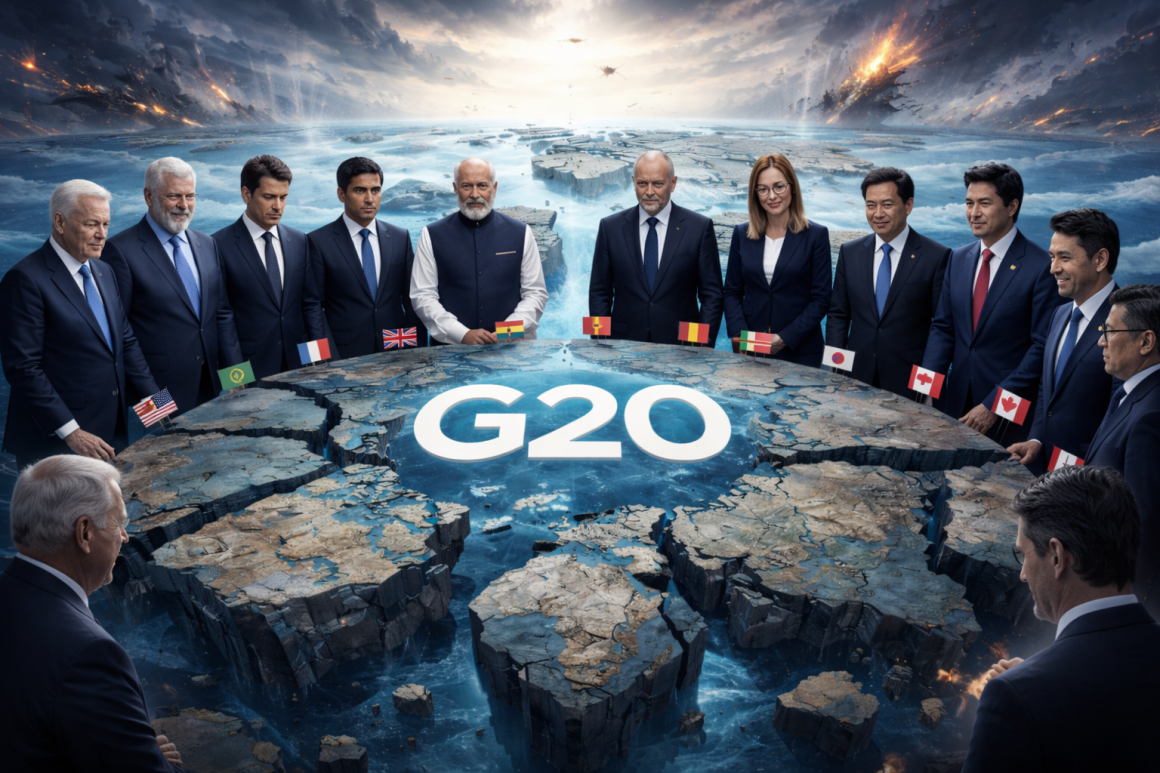

The international system today does not appear to be collapsing in any dramatic or spectacular sense. Institutions still exist. Forums continue to convene. Rules remain written down. Yet there is a growing sense that something more subtle, and perhaps more consequential, is underway. The political consensus that once gave multilateral cooperation its coherence is thinning. Compliance has become more selective. Authority is increasingly contested. Multilateralism survives in form, but struggles in substance.
It is against this backdrop that the question of the future of the G20 must be understood. The forum’s current difficulties are not simply the result of poor design or temporary disagreement, instead they reflect deeper transformations in how global power is distributed and exercised. The G20 matters not because it offers easy solutions, but because it reveals, with unusual clarity, the pressures now bearing down on global governance itself.
Unlike treaty-based institutions, the G20 is not anchored in international law and lacks enforcement mechanisms. Its legitimacy rests almost entirely on political consent, procedural convention and a shared understanding that systemically important economies carry a collective responsibility for managing global risk. When that understanding weakens, the G20 does not merely underperform, it becomes a site where structural tensions are exposed.
This dynamic was particularly evident in the context of the G20 Johannesburg Summit that marked the hosting of the group for the first time on African soil, marking an important symbolic expansion of global economic governance. It reflected both the shifting geography of economic weight and the growing assertiveness of developing and middle-income economies and it carried an implicit challenge to the inherited hierarchies within the international system.
Yet the significance of the African presidency was not confined to symbolism, instead the agenda advanced during the presidency deliberately foregrounded structural constraints, rather than cyclical fluctuations. Debt sustainability was framed as a systemic issue rooted in the architecture of global finance, not as a moral failure of borrowers; the cost of capital was elevated as a central development constraint; climate finance was reframed around access, quality and adaptation, rather than headline pledges; and critical minerals were approached through the lens of beneficiation and value retention, challenging extractive models that externalise value from developing economies.
In this sense, influence was exercised less through immediate deliverables and more through agenda-setting and in a fragmented system, shaping the terms of debate can be more consequential than securing quick agreements. Ideas migrate across forums, accumulate over time and begin to reshape what is considered legitimate to discuss. Impact, in such an environment, is cumulative, rather than transactional.
At the same time, one needs to be clear-eyed about the political constraints within which this agenda unfolded. Participation by some major economies, most notably the United States, was limited. Contestation over language intensified. Previously agreed formulations on issues such as climate action, gender, development and solidarity were no longer treated as settled reference points. In consensus-based forums, even limited resistance can exert disproportionate influence, narrowing outcomes and recalibrating expectations over time.
This pattern reflects a broader shift in global governance. Multilateral institutions derive their effectiveness not from rules alone, but from the willingness of participants to accept restraint. Yet rules do not enforce themselves, they function because actors believe restraint serves their long-term interests better than unilateral action. When that belief erodes, institutions rarely collapse outright; instead, they hollow out. Procedures continue, but their binding force weakens and participation becomes conditional and instrumental.
The G20 is particularly exposed to this dynamic: Its informality was originally its greatest strength, in that it enabled rapid coordination and candid dialogue among diverse political economies. Yet informality also carries vulnerability, because when commitment to consensus fades, flexibility can be repurposed to justify exclusion, agenda narrowing or procedural manipulation.
This vulnerability was starkly illustrated by the United Sates’ unilateral exclusion of a founding G20 member, South Africa, under its 2026 presidency. Even when framed as temporary, selective exclusion strikes at the core premise of shared participation, but more troubling still was the absence of collective resistance from other members. Silence, in such moments, is rarely neutral. Over time, acquiescence normalises exception, weakens precedent and embeds uncertainty within the institution itself.
These dynamics naturally lead to the question of institutional reform. Formal mechanisms exist, including Article 109 of the UN Charter, which provides a pathway for comprehensive review and yet the persistent failure to activate such mechanisms highlights a deeper reality: reform is not blocked by legal impossibility, but by political equilibrium. Those best placed to open the system are often those least inclined to do so.
Moreover, reform is not an unqualified good. In a deeply fragmented and power-contested international system, opening foundational texts of the UN to wholesale revision, using Article 109, for example, carries profound risk, in that the outcome of such processes may entrench imbalance or instability, rather than resolve it. Reform, in this sense, is a political gamble, rather than a technical fix.
Much of what the G20 is grappling with must therefore be understood within the broader transition from a unipolar to a multipolar world. The post–Cold War period created conditions conducive to consensus-based multilateralism. Concentrated power reduced coordination costs and allowed dominant actors to underwrite institutions even when outcomes were imperfect. As power diffuses, those conditions no longer hold. Fragmentation is not an aberration, it is a structural feature of the emerging order.
The challenge facing institutions such as the G20 is not whether fragmentation exists, but whether it can be governed. Thinner outcomes, slower consensus and heightened contestation may reflect adaptation, rather than failure. In this environment, coalitions of the willing emerge as pragmatic instruments of cooperation. Not as substitutes for multilateralism, but as adaptive responses to gridlock. Carefully structured, such coalitions may prevent paralysis while preserving institutional continuity.
Ironically, the G20 itself can be understood as an early coalition of the willing, created precisely because existing institutions proved insufficient during moments of systemic risk. Its current challenge is to adapt that logic to a more contested and crowded institutional landscape.
Finally, one must reflect on the importance of presidency cycles and continuity. The immediate transition following South Africa’s presidency includes a de facto hiatus under the current United States presidency, during which momentum is expected to slow. Cautious hope was expressed that the United Kingdom presidency may serve as a point of reactivation, even if under a different framing, followed by South Korea’s presidency, which occupies a more ambiguous position between Global South and traditional G7 orientations. The underlying concern is not intent, but continuity. Agenda gains in a fragmented system are fragile.
The future of the G20, then, is neither assured, nor foreclosed. It cannot restore a lost consensus, nor can it substitute for comprehensive institutional reform. Its value lies in functioning as a flexible platform for coordination, agenda-setting and selective alignment in a world where cooperation will be partial, imperfect and contested. The decisive factor will not be procedural design, but political choice: whether states remain willing to accept constraint in pursuit of cooperation that, while limited, remains necessary.
*This is a summary of GSPN Open Consultation Monday, held on 8 December 2025. The full report can be accessed here