
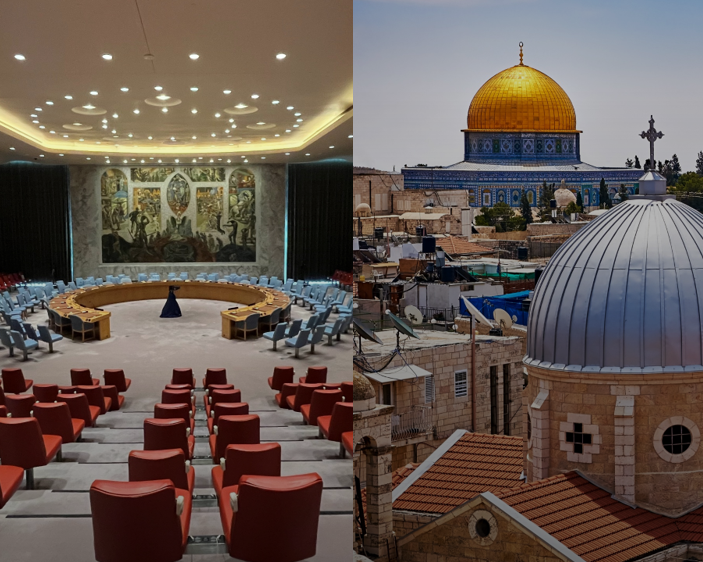

The international community has become preoccupied with reforming its institutions. We debate the future of the United Nations Security Council, the composition of the G20, the legitimacy of international financial institutions and the emergence of a more multipolar world. These are important conversations, but they all risk overlooking a more fundamental problem.
The world is not suffering only from an institutional crisis. It is suffering from a crisis of moral authority.
International institutions derive their legitimacy not merely from their legal mandates or constitutional structures, but from the confidence that nations and citizens place in them and therefore rules only command respect if they are applied consistently, leadership is only accepted if it is exercised responsibly and power only becomes legitimate when it is restrained by principles larger than itself.
That confidence is steadily eroding.
Around the world, people increasingly question whether international law is applied equally to all, whether global institutions still represent the interests of humanity, rather than those of the most powerful, and whether diplomacy has become little more than the management of competing interests instead of the pursuit of justice. The result is an international order that continues to function institutionally, but struggles to command moral legitimacy.
This is not simply a political problem. It is an ethical one.
These questions formed the basis of a recent dialogue hosted by the Global South Perspectives Network under the theme ‘In Search of Moral Authority: Religion, Civilisations and the Return of Faith to International Affairs’. Bringing together religious leaders, scholars and diplomats from different traditions, the discussion arrived at a surprisingly consistent conclusion. Whatever our religious beliefs, the international community cannot rebuild trust without rebuilding its moral foundations.
Importantly, this is not an argument for religion to govern politics. Nor is it a call to replace secular institutions with religious authority. Democratic governance and religious freedom depend precisely upon maintaining that distinction.
But there is an equally important distinction that is often overlooked: separating religion from the machinery of the state does not require excluding moral values from public life.
For much of the twentieth century, many assumed that modernisation would steadily reduce the influence of religion in public affairs. But the opposite appears to be happening. Across Africa, Asia, Latin America and much of the Middle East, faith continues to shape public life, ethical reflection and community identity. Even in societies that regard themselves as increasingly secular, people continue to search for meaning, justice, responsibility and hope, questions that politics alone has never been able to answer.
Perhaps the issue, then, is not that religion has returned to international affairs. It is that we are rediscovering something that never truly disappeared.
The discussion highlighted a profound paradox. Humanity possesses unprecedented technological capability, scientific knowledge and economic power. Artificial intelligence is transforming entire industries. Communication occurs instantaneously across continents. But our ability to answer the oldest political questions appears no stronger than before.
- What constitutes justice?
- How should power be exercised?
- What responsibilities do nations owe one another?
- How do societies preserve human dignity amidst conflict and competition?
Technology can assist us in answering many practical questions. It cannot answer moral ones.
One of the most compelling observations made during the discussion was that the central challenge confronting the international community is no longer simply who possesses the greatest military or economic strength. Increasingly, the more important question is: Who can still be trusted?
Trust has become the scarce commodity of international politics. When identical actions are judged differently depending upon who commits them, confidence weakens. When international norms appear to be enforced selectively, legitimacy suffers. When power becomes detached from responsibility, institutions continue to exist, but their authority steadily diminishes.
This is why structural reform alone will not be enough.
Reforming the Security Council, modernising global financial institutions or redesigning multilateral structures may improve representation, but no institutional architecture can substitute for integrity and no constitutional amendment can manufacture trust. And no treaty can compel moral leadership.
The discussion also offered an alternative understanding of power itself.
Power is not inherently problematic. Every nation has legitimate security concerns, economic aspirations and national interests. The difficulty arises when power becomes an end in itself, rather than an instrument of service.
This insight was captured powerfully in the contrast between what one speaker described as a “culture of power” and a “civilisation of love”. Stripped of its theological language, the idea is profoundly practical. It challenges leaders to exercise authority with humility, to temper strength with restraint, and to recognise that genuine leadership is measured not only by what a nation can compel others to do, but by the trust it inspires.
The African philosophy of Ubuntu expresses much the same idea. “I am because we are” reminds us that neither individuals nor nations flourish in isolation, in that our security, prosperity and stability are increasingly interdependent. In an age of multipolarity, this lesson has become more relevant than ever.
Perhaps that is the greatest challenge facing global governance today.
The debate about the future international order often focuses on which countries should wield greater influence. Far less attention is given to the values that should guide that influence. A more representative international system will not automatically become a more legitimate one if it continues to lack ethical consistency.
The search for moral authority is therefore not about elevating one religion, one civilisation or one political philosophy above another. It is about recovering universal virtues that have long underpinned peaceful coexistence: integrity, justice, humility, responsibility and respect for human dignity.
- Without these virtues, institutions become procedural, rather than principled.
- Without them, diplomacy becomes transactional, rather than transformative.
- Without them, power increasingly becomes an end, rather than a means.
The international community undoubtedly needs institutional reform, but perhaps even more urgently, it needs leaders, and institutions, that once again deserve to be trusted.
The future of the international order will ultimately depend not only on who possesses the greatest power, but on who exercises that power with the greatest moral responsibility.
That is a conversation whose time has come.