
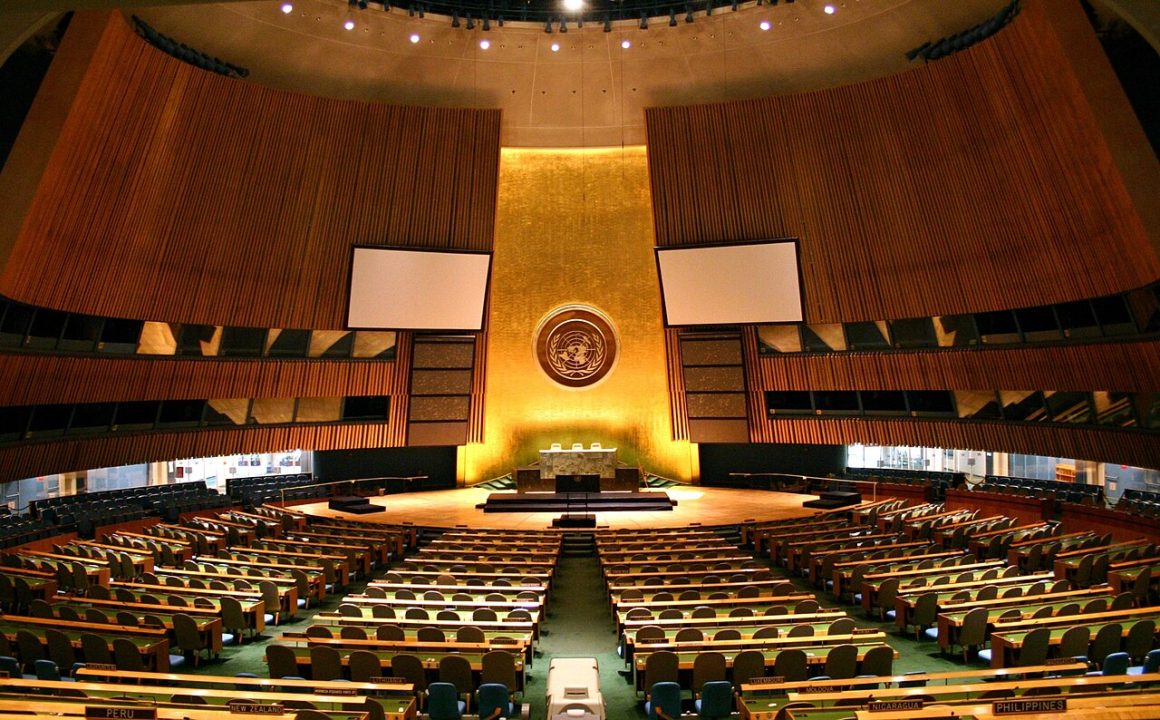

The international order is changing before our eyes. Great-power rivalry is once again dominating global politics. Strategic competition increasingly overshadows cooperation. International law is applied inconsistently, if at all. Trust in multilateral institutions is weakening. The temptation is to conclude that the age of effective multilateralism is drawing to a close. That would be a mistake.
The challenge confronting the United Nations today is not that multilateralism has become obsolete. On the contrary, humanity has never before been in such desperate need of it. Climate change, pandemics, artificial intelligence, migration, food insecurity, cyber threats and armed conflict all transcend national borders. None can be solved by even the most powerful state acting alone.
The real problem is political. The institutions remain. What is increasingly absent is the political will and the leadership needed to make them work.
Much of the current debate assumes that the future of the international system depends almost exclusively on the behaviour of the world’s major powers. Every development is analysed through the prism of Washington and Beijing. Every diplomatic initiative is measured against the actual or expected reactions of Moscow, Brussels or New Delhi. Smaller actors are too often treated as spectators rather than participants. That assumption deserves to be challenged.
The future of multilateralism may depend less on whether the major powers agree – and actually who would like them to agree all the time in ways that might impose their agreements on others? – than on whether the rest of the international community is prepared to step up to the table, assert its co-ownership and exercise greater responsibility.
This is where middle powers enter the picture.
Middle powers occupy an unusual position within the international system. They command significant resources – political, diplomatic, financial, cultural or otherwise – but generally lack the military or economic strength to impose outcomes unilaterally. That has often been viewed as a weakness. In today’s fragmented geopolitical environment, however, it may prove to be one of their greatest strengths.
Unable to rely on coercion, middle powers have historically relied on persuasion, coalition-building, mediation and international law. They have learned that influence can be exercised through dialogue, rather than dominance. Many retain productive relationships across competing political camps. They often enjoy credibility in both the Global North and the Global South. These are precisely the diplomatic qualities that have become scarce.
Examples already exist. Countries such as Brazil, Indonesia, South Africa and Norway have demonstrated that influence is not measured solely by military capability or economic size. They have shaped debates, facilitated negotiations and advanced practical cooperation on issues ranging from sustainable development to conflict mediation. The Ottawa Process, led by Canada together with countries including South Africa and Norway, showed how a coalition of middle powers could reshape international norms through the adoption of the Anti-Personnel Mine Ban Convention. More recently, the cross-regional Accountability, Coherence and Transparency (ACT) Group has demonstrated how middle powers can collectively influence debates on Security Council reform and the responsible use of the veto. Their influence has stemmed from their ability to build bridges, rather than deepen divisions. But these efforts remain largely issue-specific and episodic, rather than forming part of a sustained strategy to strengthen the multilateral system itself.
Middle powers cooperate effectively among themselves on individual issues, but have not yet translated that experience into sustained collective leadership for the multilateral system itself. There is no coherent middle-power agenda aimed at strengthening global governance at precisely the moment when such leadership is most needed. This is the opportunity.
There is no need to create another geopolitical bloc. The world already has enough competing alliances. Nor do middle powers need to abandon their national interests or pretend that their differences do not exist. Instead, something far more practical is required.
Middle powers should develop the habit of regular strategic consultation. They should identify areas where interests genuinely overlap: preventive diplomacy, food security, public health, climate resilience, humanitarian assistance and technological governance, and build durable coalitions around those issues. Overall, they should consistently defend the principles and practices of the United Nations Charter and international law, regardless of which countries happen to be involved in disrespecting them.
Perhaps most importantly, they should stop defining themselves primarily by their relationships with great powers.
Middle powers are often described according to what they are not. They are not superpowers. They are not permanent members of the UN Security Council. They are not global hegemons. But they possess something increasingly valuable: the ability to maintain principled dialogue where others have chosen confrontation or capitulation.
The appointment of the next UN Secretary-General presents an ideal opportunity to put this approach into practice.
The Secretary-General cannot revitalise multilateralism through moral authority alone. The Office requires sustained political support from Member States that are genuinely committed to international cooperation. A coalition of middle powers could provide precisely that support, not by directing the Secretary-General, but by creating greater political space for principled leadership, preventive diplomacy and practical cooperation. Equally important is the need to recover the public narrative around multilateralism itself.
International cooperation has become associated almost exclusively with institutional deadlock, geopolitical rivalry and diplomatic failure. But this tells only part of the story. Multilateral cooperation has contributed enormously to improvements in health, education, poverty reduction, human rights and sustainable development, and has averted major confrontations, over the past eight decades since World War II. Those achievements deserve to be remembered.
If multilateralism is to regain public confidence, it requires a more compelling story, one that recognises today’s challenges without surrendering to pessimism.
The opening words of the United Nations Charter, “We the Peoples”, remind us that international cooperation ultimately exists not to preserve institutions, but to improve the lives of people. That remains the raison d’être of the institution.
The international order has etered a period of profound transition. Institutional reform will undoubtedly be necessary. But institutions alone cannot restore confidence. They require political leadership, trust and governments willing to invest in cooperation even when disagreement persists.
Middle powers cannot solve every global problem. Nor should they aspire to replace the major powers.
But they can do something equally important.
They can demonstrate that dialogue remains possible, that international law still matters, and that cooperation remains humanity’s most practical response to shared challenges.
The future of multilateralism will not be decided only in the capitals of the world’s most powerful states. It may well depend on whether those in the middle decide that waiting on the sidelines is no longer an option.

Daryl Swanepoel is the Chief Executive Officer of the Inclusive Society Institute and a Research Fellow at the School of Public Leadership, Stellenbosch University. He is a leading voice on global governance reform. With a career spanning politics, business, and academia, he has served as a parliamentarian, strategist, and educator. His current focus includes work on reimagining the UN system, challenging entrenched power dynamics, and driving inclusive solutions.