
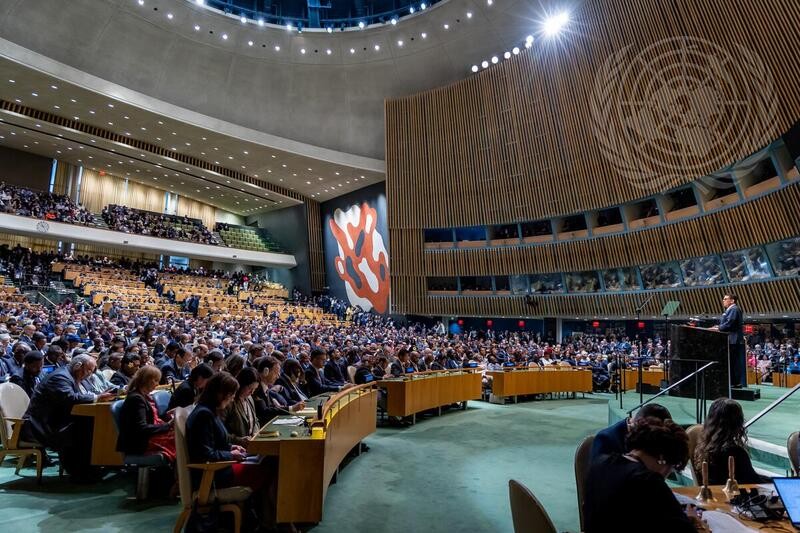

Multilateralism is under pressure when conflict, climate change, inequality, food insecurity and technological disruption cannot be addressed by countries acting alone. The question is not whether multilateral cooperation remains necessary, but how it can become more responsive to the realities of our time and regain public trust. Renewed multilateralism must be judged not only by institutional reform but by whether it delivers tangible improvements in people’s lives.
The United Nations Charter begins with “We the peoples,” placing equal rights, justice and international cooperation at the heart of the organisation. The UN’s Our Common Agenda called for inclusive, networked and effective multilateralism, while the Pact for the Future, (2024) committed governments to strengthening and transforming the multilateral system. The question is how countries with influence, but without great‑power capabilities, can contribute to this renewal.
What Can Middle Powers Contribute?
There is no single accepted definition of a “middle power.” Scholarship considers both capabilities and behaviour, including multilateralism, coalition‑building, mediation and “niche diplomacy”. This approach creates space for countries such as Brazil, Indonesia, South Africa, Norway, Oman and Qatar, among others, to exercise influence through dialogue, regional cooperation and multilateral forums. Their significance lies not simply in their capabilities, but in how they use them.
Middle powers, however, should not be idealised. Their foreign policies are shaped by national interests, security concerns, economic pressures and strategic relationships. Their contribution therefore raises a fundamental question: is there consistency between principles and practice?
The Test of Consistency
This suggests a useful distinction between “authentic middle‑power diplomacy” and the aspiration to great‑power status. This is not a permanent classification of countries, but an analytical lens for examining diplomatic conduct. A middle power can exercise influence by building coalitions, facilitating dialogue, supporting law and creating space for countries with less diplomatic or economic weight. Its credibility depends on applying these principles even when politically difficult.
The distinction matters in an increasingly multipolar world. Multipolarity can widen the distribution of power, but it does not automatically make global governance more representative, accountable or equitable. The test is whether newly distributed influence changes how institutions respond to people affected by their decisions.
BRICS and the Question of Representation
The recently concluded 18th BRICS Summit in New Delhi makes this discussion timely. The New Delhi BRICS Declaration reaffirms equality, inclusiveness, international law and the UN’s central role, while calling for a more just and accountable multilateral system. It also addressed international peace and security, including the conflicts in Palestine and Syria, and stressed dialogue, preventive diplomacy, mediation and respect for humanitarian law.
Yet a declaration cannot by itself demonstrate renewed multilateralism. The question is whether a grouping as diverse as BRICS can translate commitments into collective action when its members have competing interests, strategic relationships and divergent positions on conflicts. Recent difficulties in reaching common positions on major geopolitical questions underline this challenge.
This is where BRICS becomes a useful test of the middle‑power argument. Greater representation can give countries more diplomatic space and a stronger voice in shaping global rules. But influence can be used in different ways: to build bridges, widen participation and strengthen multilateral institutions, or to consolidate another centre of geopolitical power. The distinction between an authentic middle‑power approach and the aspiration to great‑power status therefore becomes important – not as a classification of countries, but as a test of conduct.
The question is whether BRICS and other emerging coalitions can use influence to make multilateralism more representative without reproducing power politics. Their credibility will depend on the consistency between the principles they affirm and the choices they make when those principles become politically difficult.
Working with the Next UN Secretary‑General
This debate is especially relevant as the selection of the next UN Secretary‑General nears its conclusion. The new Secretary‑General will take office in January 2027, following interactive dialogues with candidates involving Member States and civil society.
To succeed, the Secretary‑General will need Member States to support an independent UN, preventive diplomacy, humanitarian cooperation and existing commitments. Middle powers can help by defending the institutional independence and integrity of the UN, investing in mediation before conflicts escalate, building coalitions on climate, food security, development finance, digital governance and peacebuilding, and widening dialogue by engaging civil society, youth and smaller states whose voices are often less visible.
In the end, the real test of middle‑power influence is not whether it creates another hierarchy, but whether it makes multilateralism more responsive, accountable -capable of delivering peace, dignity, justice and shared security.
From Influence to Shared Responsibility: Building Bridges
The renewal of multilateralism will not come from one institution, one country or one diplomatic grouping. It will require sustained cooperation across different centres of power. Middle powers need not become great powers in another form. Their distinctive contribution can be to build bridges, create dialogue and translate principles into practical cooperation that strengthens institutions rather than reproduces existing hierarchies of power.
What might such a world look like? It would be one in which countries use their diplomatic space to prevent conflicts before they escalate, defend international law even when politically difficult, and ensure that decisions on food, climate, development and technology are shaped by those most affected. Representation would mean more than having additional countries at the table; it would mean that their participation can influence decisions and make a difference in people’s lives.
But greater influence can also produce new rivalries, competing blocs and another struggle for status. The challenge for middle powers, therefore, is not simply to seek a larger place in the international order, but to use that place responsibly. Their contribution to the renewal of multilateralism depends on whether their growing influence is matched by accountability, consistency and a willingness to share responsibility. Ultimately, the true test for middle powers lies in putting people, principles and practical cooperation at the centre of global governance.

Sudha Sreenivasa Reddy is Director of the Eco Foundation for Sustainable Alternatives, consultant with the Centre for Child and the Law, National Law School of India University, Bengaluru, India and a former Advisor to FOGGS. Her work spans peacebuilding, climate justice, gender justice, food and nutrition security, and the inclusion of vulnerable persons with disabilities, religious minorities, and sexual minorities, across practice, advocacy, policy, research, and community engagement. Drawing on Gandhian ethics, feminist peace theory, and Global South perspectives, her writing engages conscience, justice, and lived realities. She is a recipient of the Maya Koene International Peace Award (2025).