
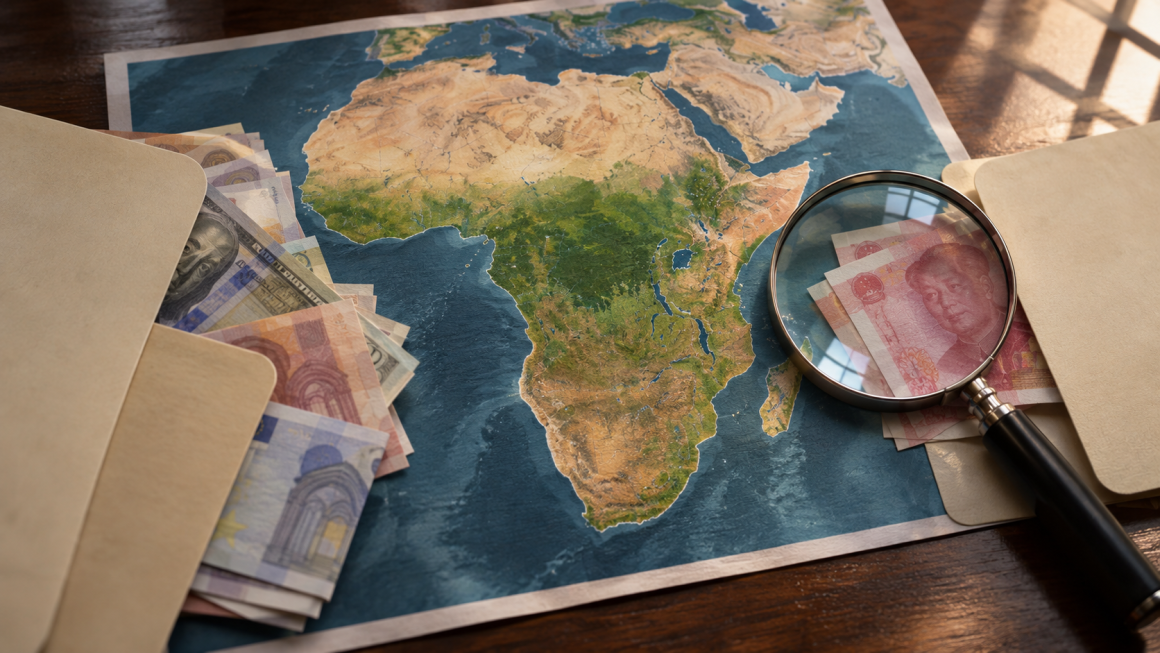

When Western policymakers warn Africa about Chinese lending, a reasonable question arises: are they concerned about Africa’s debt, or about who Africa owes?
The distinction matters. A genuine concern for African development should produce consistent scrutiny of every lender. It should ask whether borrowing is affordable, whether contracts are transparent, whether projects justify their cost and whether creditors cooperate when repayment becomes impossible. These questions should apply equally to a Chinese policy bank, a European commercial bank or an American investment fund.
But the political warning so often centres on China. African governments are cautioned against surrendering their sovereignty through Chinese financing, as though borrowing from elsewhere carries no comparable dangers. The language is sometimes explicit. An official US State Department statement described China’s approach as involving opaque contracts and predatory lending that undermine sovereignty and encourage dependency.
Such allegations deserve examination. They also invite a question about the credibility of those making them. If the concern is that debt can constrain Africa’s choices, why does the warning become so much quieter when the creditor sits in London or New York?
Consider one revealing comparison. In a study published in 2022, the British organisation Debt Justice calculated, using World Bank data, that Chinese public and private lenders held approximately 12% of African governments’ external debt. Non-Chinese private creditors held approximately 35%, almost three times as much. Debt Justice described the latter group as Western banks, asset managers and oil traders, although its underlying statistical category was private creditors excluding China.
That qualification matters. We should not pretend that every non-Chinese private creditor is American or European. But neither should we overlook the central finding: Chinese lending accounted for a minority of the debt, while other private lending accounted for a substantially larger share.
More recent World Bank figures reinforce the broader point. For sub-Saharan Africa in 2024, private creditors held about 40% of public and publicly guaranteed external debt, including IMF credit in the comparison. China’s bilateral creditor category accounted for about 10%. These figures have different coverage from the earlier study, and private creditors include lenders of different nationalities. Nevertheless, they hardly describe a continent whose public external debt is overwhelmingly controlled by China.
The cost of borrowing makes the selective warning more difficult to defend.
The same Debt Justice study reported average interest rates of approximately 5% on non-Chinese private loans, compared with 2.7% on Chinese loans. These are historical averages, not quotations for loans available today. They nevertheless show that the financing attracting the loudest political warnings was, on that measure, considerably cheaper than financing from the larger private-creditor group.
One might reasonably expect policymakers concerned about African debt to devote considerable attention to that difference. Higher interest payments consume resources that could otherwise support schools, hospitals, infrastructure and economic development. An expensive loan does not become benign because its lender operates within a Western financial system.
None of this gives China a free pass.
Research by AidData published in 2025, drawing on an expanded sample of 371 contracts across 60 countries, confirmed extensive use of confidentiality provisions, collateral arrangements and clauses excluding loans from Paris Club restructuring. Such provisions warrant scrutiny. Governments should know what revenues they are committing, what information they may disclose and how a contract could constrain their options during a crisis.
But troubling contractual provisions and a deliberate strategy to trap countries are different propositions. The latter requires evidence of intent and conduct. It cannot simply be assumed whenever a Chinese-financed project encounters financial difficulties.
Chatham House’s examination of Chinese lending in Africa challenges the idea of a sophisticated strategy to expropriate African assets. Its findings point instead to poorly judged lending, difficult projects and negotiations in which African governments also exercise agency. Chinese financing can contribute to debt distress without every failed project proving a geopolitical trap.
The distinction is essential if the debate is to inform, rather than frighten.
Africa is not a single borrower. A financing arrangement that works for one country may be disastrous for another. A road, power station or railway may expand productive capacity sufficiently to justify borrowing. Another project may be overpriced, poorly selected or incapable of generating the expected benefits. These judgments require examination of the project and its financing.
The lender’s nationality cannot substitute for that work.
Nor can African governments escape responsibility. Leaders who sign unaffordable contracts, conceal commitments or borrow for prestige, rather than public benefit must answer for their decisions. Treating Africa merely as the passive victim of foreign schemes diminishes the responsibility of its governments and the agency of its people.
The same principle applies to creditors. They should be judged by their lending practices and their conduct when difficulties arise. Do they disclose terms? Do they assess repayment capacity responsibly? Do they cooperate in restructuring? Do they share the losses from failed lending, or insist that citizens bear the entire adjustment?
These are fair questions for all lenders.
The accusation of hypocrisy therefore does not require a claim that the West deliberately traps Africa. It arises when Western policymakers single out Chinese financing as a threat while giving insufficient attention to larger and often more expensive lending associated with their own financial systems.
Specific criticisms of China may still be valid. But their credibility is weakened when the standards behind them are applied selectively. A warning offered in Africa’s interests should remain the same when the identity of the creditor changes.
Otherwise, Africans are entitled to wonder whether their welfare is the overriding concern, or whether their financial relationships have become another arena for great-power competition.
Africa needs investment, infrastructure and access to affordable capital. Its governments should negotiate firmly with China, Europe, the United States and multilateral institutions alike. They should reject bad agreements wherever they originate and pursue useful financing wherever it can be secured.
Western policymakers can make a valuable contribution by promoting transparency, responsible lending and workable debt relief throughout the financial systems over which they have influence. That would give their warnings substance.
Until then, the question remains: if Africa’s debt is the concern, why does the identity of the lender so often determine the intensity of the warning?

Daryl Swanepoel is the Chief Executive Officer of the Inclusive Society Institute and a Research Fellow at the School of Public Leadership, Stellenbosch University. He is a leading voice on global governance reform. With a career spanning politics, business, and academia, he has served as a parliamentarian, strategist, and educator. His current focus includes work on reimagining the UN system, challenging entrenched power dynamics, and driving inclusive solutions.