

In last Sunday’s mass, I heard a Christian priest declare during Mass that “this planet is useless, transitory” and that we should therefore focus on the heavens and the “next life.” Believer or not, the implications of this statement in everyday practical terms are troubling. They resonate, almost surreptitiously, with the rhetoric of Elon Musk and his faction, who argue for colonizing Mars for spatial diversification if nothing else, rather than backing efforts on reversing climate change and environmental degradation on Earth.
Similarly, they echo the attitude of certain technology magnates who appear to be giving up on the natural and focusing on artificial intelligence instead, notwithstanding AI’s reliance on human training and input.
Yet nowhere in the Bible does God or Jesus preach abandoning this planet by default because something better lies ahead. On the contrary, God is described as the creator of all living creatures, promoting life and encouraging its procreation. The physical Earth itself is consistently viewed as God’s good creation with an important purpose. Ethical injunctions such as “love thy neighbour” and “do unto others as you would have them do unto you” can be justifiably extended to include the living environment.
Taken literally, the priest’s statement risks legitimizing destructive practices: wearing a cross while polluting seas and rivers, cutting down forests for profit, succumbing to nihilism, or even embracing violence under the guise of awaiting divine relief. If “this life” is dismissed as futile, why bother preserving it? The priest further claimed that “life would be easy if we put the living in God’s hands,” as though entrusting God would prevent children from dying of leukaemia, malnutrition, or in ongoing conflicts and active aggressions. Such simplifications are deplorable. It is truly deplorable that those who believe they have the prerogative of interpreting the Bible and the word of God for us should indulge in frivolity, even if using it figuratively. And even if allegory is understood, it still leaves one with not an uplifting feeling but more of a deep depression and sense of futility of efforts in this life on Earth.
This rhetoric, based on the simplification of the promise of afterlife, directly contradicts late Pope Francis’ Laudato si’ / Praise Be to You – the first ever papal encyclical devoted entirely to ecology. Pope Francis emphasizes care for our “common home” – the Earth, and links environmental responsibility with justice for the poor, social solidarity, and inner peace. He warns against unchecked resource exploitation and the “technocratic paradigm” that prioritizes profit over ethics, urging individuals and communities to change lifestyles, reduce consumption, and embrace responsibility for creation. In its humanitarian, action-oriented vein, it highlights that environmental degradation disproportionately harms vulnerable populations. What it does not do is advocate giving up on this planet in anticipation of the next life.
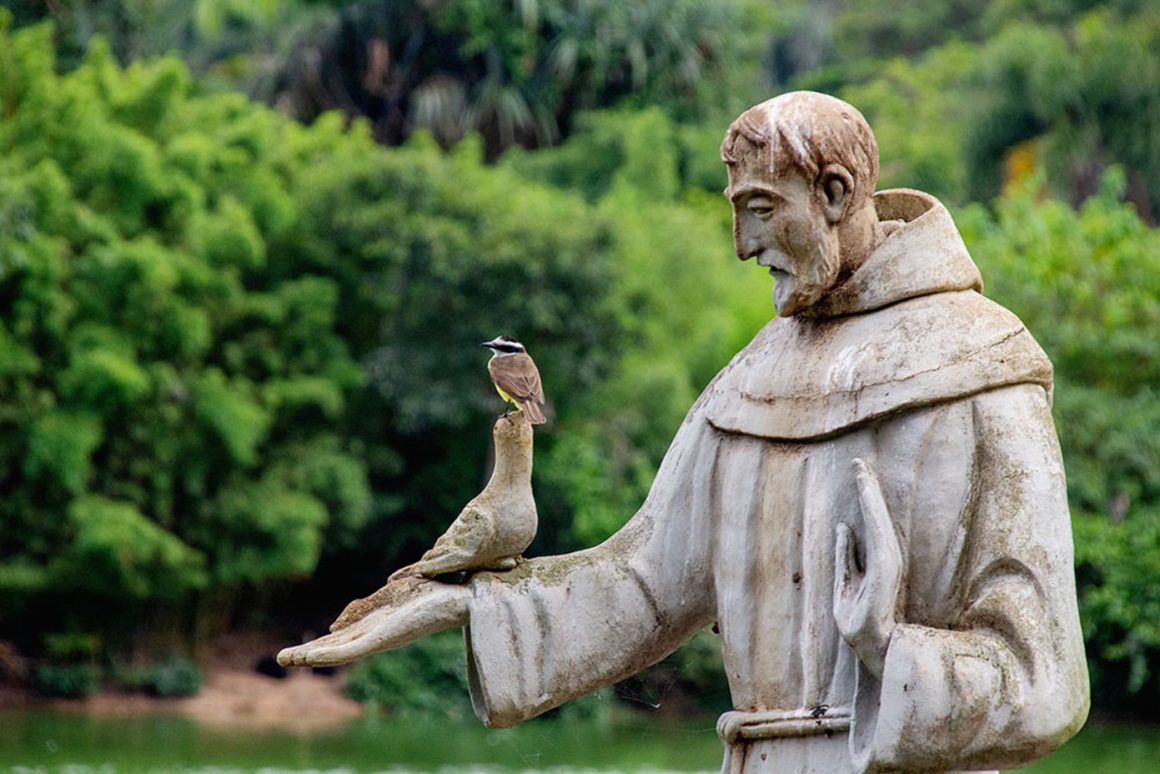
Pope Francis was inspired by Saint Francis of Assisi, who referred to natural elements and animals as kin – “Brother Sun,” “Sister Moon,” “Brother Wolf” – thus rejecting human domination over nature. He saw the earth not merely as matter but as a mirror of divine love and grace.
In this sense, Saint Francis can be seen as a precursor to modern environmental voices such as David Attenborough, who similarly frames the natural world as a fragile, interconnected system deserving reverence and protection. Attenborough’s documentaries and writings, much like Saint Francis’ Canticle of the Creatures, speak to all people of good will, urging humanity to recognize the beauty and vulnerability of our common home.
As the Head of State and not just the Catholic Church, late Pope Francis recognized the importance of the moment in which countries were lowering environmental issues on their list of priorities. Politicians often focus on short-term, visible successes that win votes, while neglecting costly, complex challenges such as decarbonisation. Almost half of European Union member states are missing their 2030 climate targets under the Effort Sharing Regulation (ESR) and related legislation, and hence satisfying themselves with paying ensuing financial penalties from taxpayers’ pockets. Francis’ intervention was therefore both theological and political, reminding states that environmental responsibility is inseparable from social justice.
The current Pope Leo XIV, of the Augustinian order, has addressed climate change, migration, church governance, and human rights. As pope, he has consistently opposed armed conflict and exclusionary nationalism, advocated for immigrants, and warned against unregulated artificial intelligence. His stance, like that of his predecessor Pope Francis, contrasts sharply with nihilistic clerical interpretations and techno-utopian escapism.
International law also recognizes environmental protection as a legal obligation, in times of peace and in times of conflict, both internal and international, codified in the 1977 Additional Protocols to the Geneva Conventions and the 1976 ENMOD Convention.
Most importantly, and charting a new path for the Church, Laudato si’ drew on contemporary climate and environmental research, urging collaboration between faith and science. What it did not do is give up on this planet, urging focus on the next life alone – for would it not be the wrong, ungodly approach to disregard this life and planet and simply await the next.
As the late Pope Francis reminds us, humanity must “listen to the cry of the earth and the cry of the poor”. Let God therefore decide whether and when we will be granted everlasting life and let us decide collectively and responsibly, through the United Nations, on whether, how, and when humanity would colonise Mars and without delegating that responsibility, and our own intelligence, humanity even, to AI – we must maintain human digital sovereignty.
Meanwhile, as both saints and scholars seem to be telling us, our responsibility is to make the best of this life, acting in goodness toward people and nature. That ought to suffice to prepare us for any life thereafter.