
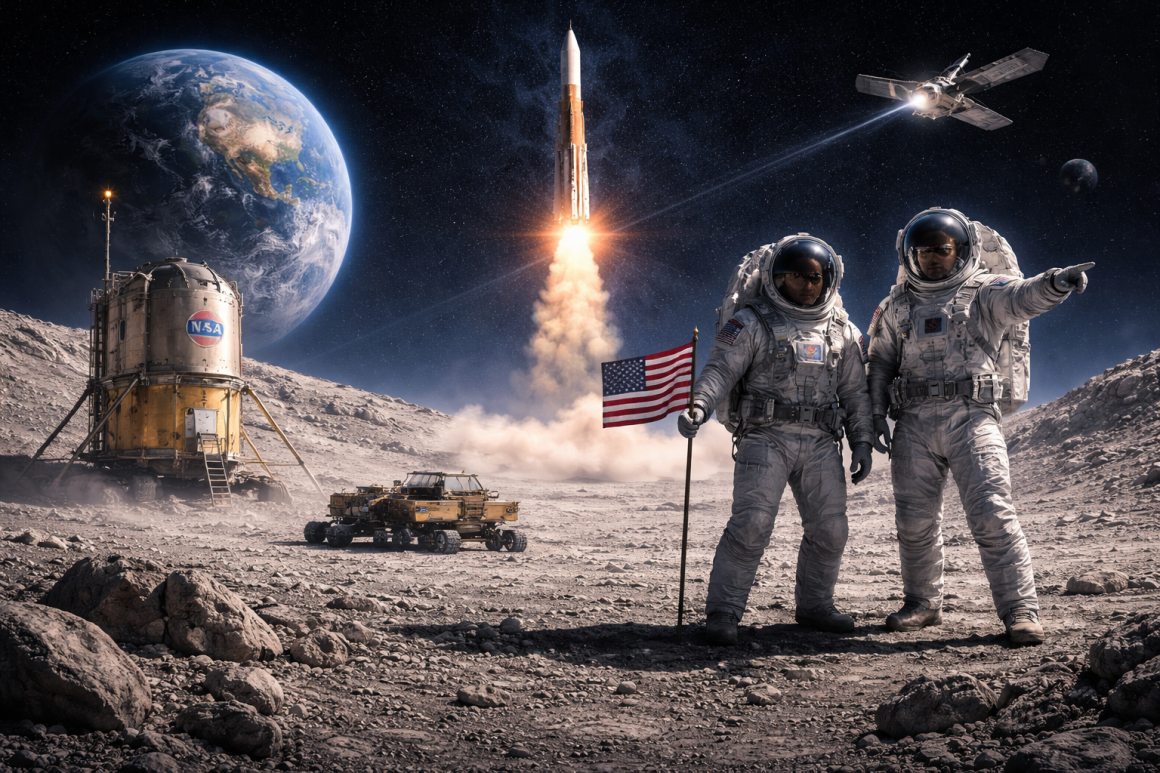

Obscured from view by the Iran War and the generalized turmoil it has caused, with Ukraine, Sudan, Gaza and other hotspots also competing for the limelight, a major step is about to be taken for humanity’s future. The Artemis Program of the US National Aeronautics and Space Administration (NASA) is about to launch its first crew into space. The aim: “to explore more of the moon for scientific discovery, economic benefits, and to build on our foundation for the first crewed missions to Mars”. Launch has been postponed in previous weeks for technical reasons, but it now seems most probable that the Orion spacecraft will lift off on or around 1 April 2026, opening the way for an eventual landing on the moon in 2028.

This is no Fools’ Day joke. It is an ambitious project that deserves more public attention, as it has the potential to inspire people rather than depress them, unlike most other news items these days. The project’s narrative also draws on ancient Greek mythology, where Artemis was the goddess of the moon, while her twin brother Apollo was the god of the sun. The connection is thus apparent to the Apollo Program of NASA that sent the first people to the moon in the late 1960s and early 1970s.
Of course, in addition to the science and human destiny aspects, there are lots of underlying interests and calculations packed in this hi-tec endeavour. Reading through the Artemis Program website it becomes clear that “maintaining American leadership in exploration” comes first for the US side, but there is also the stated intention to “build a global alliance and explore deep space for the benefit of all”. A framework for such an alliance has been set up through The Artemis Accords established in 2020 by the US (NASA working in coordination with the US State Department) and seven other countries. The number of signatories had reached 61 countries by January 2026.
Although this diversity is not reflected in the initial crew – which consists of three Americans, one of them a woman, and a Canadian man – there is more than what meets the eye. For example, several European countries have contributed to the technology that supports the Artemis Program and the specific launch, while the Orion service module has been built by the main contractor of the European Space Agency (ESA), Airbus. The lead contractor on the US side is Lockheed Martin, while other US contractors include L3Harris, Boeing, and Northrop Grumman. For the eventual landing on the moon in the coming years, Jeff Bezos’ Blue Origin and Elon Musk’s SpaceX have been contracted by NASA to develop lunar landers.

Source: https://www.nasa.gov/artemis-accords/
The rationale for the Artemis Accords has been that “With many countries and private companies conducting missions and operations around the moon, the Artemis Accords provide a common set of principles to enhance the governance of the civil exploration and use of outer space.” It is important to note that the Accords “reinforce the commitment by signatory nations to the [United Nations] Outer Space Treaty, the Registration Convention, the Rescue and Return Agreement, as well as best practices and norms of responsible behavior for civil space exploration and use”.
Up to this point, the news is good and is exactly the kind of news that should get more publicity worldwide. Here the fairy tale apparently ends, though. The ambition of the Artemis Program is being reduced under budgetary cuts introduced by US President Trump’s second administration. Moreover, unlike for the International Space Station, where the US and Russia cooperate and cohabitate no matter what their relations on earth may be, when it comes to landing on the moon Russia has chosen to join China’s mission that aims at a lunar landing in 2030. China and Russia’s International Lunar Research Station (ILRS) is supposed to be built on the lunar surface by 2036 and is open to participation by other countries. Some 17 countries and international organizations, as well as more than 50 international research institutions, had reportedly joined the project by April 2025. It is interesting to note that the ILRS will be powered by a Russian nuclear power plant.
So, when Orion lifts off on or around 1 April it will be carrying with it only one part of humanity. It will thus be also carrying humanity’s divisions and geopolitical (or should we say “interstellar”?) competition. It is not difficult to foresee the conflicts that may also come sooner than later, the battles for the moon’s resources, the destruction of each other’s infrastructure and eventually slow-motion deaths in the moon’s light gravitational field. The self-interest, greed, hatred and murderous instincts that characterize “brotherly relations” on earth will then “shine” on the moon too, after that Mars and the entire universe.
Of course, the environment will suffer there too, from resource extraction and other abuse. The moon may not have beautiful green forests and turquoise seas to pollute, not even an atmosphere to make unbreathable, but it will be degraded compared to what it is today, that is for sure. Future generations may be able to see from earth a different full moon, with new craters left after intense mineral extraction, nuclear explosions, accidents and spills of all kinds. And of course, those who will have benefited the most from all this activity will be the big, powerful countries and the gigantic, super-rich people and companies, while developing countries and the average citizen of countries big and small will have got comparatively worse off.
It does not need to turn out this way. There is already in place an international legal framework that governs activities in outer space, from orbiting the earth to landing on the moon or other celestial bodies. The cornerstone of this framework is the Outer Space Treaty of 1967 that embodies principles like “the freedom of exploration and use of space for the benefit and interest of all countries, the non-appropriation of outer space, including the moon and other celestial bodies, and the prohibition of the deployment of nuclear weapons or other kinds of weapons of mass destruction in outer space”. There is even a dedicated “Agreement Governing the Activities of States on the Moon and Other Celestial Bodies” adopted by the UN General Assembly in 1979. Article 11.1. of the Agreement clearly states that “The moon and its natural resources are the common heritage of mankind,” while Article 4.1. talks about the exploration and exploitation of the moon:
Article 4.1. The exploration and use of the moon shall be the province of all mankind and shall be carried out for the benefit and in the interests of all countries, irrespective of their degree of economic or scientific development. Due regard shall be paid to the interests of present and future generations as well as to the need to promote higher standards of living and conditions of economic and social progress and development in accordance with the Charter of the United Nations.
In view of the further intensification of lunar activities in the coming years, the UN General Assembly, the Committee on the Peaceful Uses of Outer Space and its Legal Subcommittee, as well as the UN Secretariat’s Office for Outer Space Affairs (UNOOSA), need to follow developments closely and innovate in terms of governance, as necessary for the Agreement’s implementation. That could include a special administrative unit to monitor activities by all state and non-state actors on and around the moon, as well as a Special Envoy of the UN Secretary-General for Lunar Affairs. Letting things develop “organically” while competition for resources increases, on the moon too, among state and non-state actors, may allow the establishment of faits accomplis on the ground and eventually lead to conflict and destruction.

Dr Georgios Kostakos is Co-founder and Executive Director of the Brussels-based Foundation for Global Governance and Sustainability (FOGGS). He has been a UN staff member, including with the Executive Office of the UN Secretary-General, the High-level Panel on Global Sustainability, the UN Framework Convention on Climate Change (UNFCCC), and field missions for political affairs and human rights. He has also worked with think tanks, academic institutions and as a consultant on global governance and sustainability, peace and resilience.