
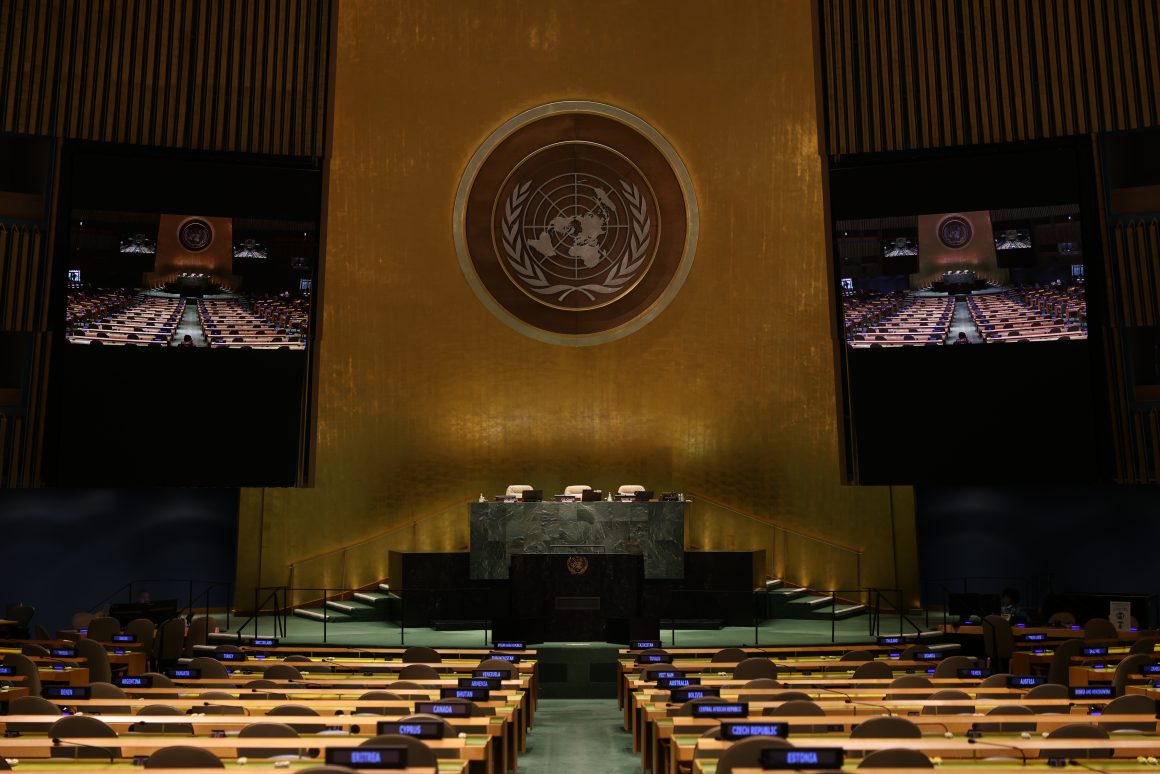

At a time when criticism of the UN is constantly resurfacing, and a state that claims to rule the world is striving to dismantle it, I believe it is timely to defend the imperative of global governance.
The contemporary international order is the result of a long process that took root in the 17th century with the Treaty of Westphalia (1648), an order born of a peace among nascent nation-states, concerned with their internal order and borders, determined to settle their disputes through diplomacy and treaties. This era also saw the birth of international law (the jus gentium, conceptualized and formalized by Grotius, the father of international law).
Since then, the world has steadily moved toward an international order governed by law and negotiation. The first major international negotiations to resolve conflicts and restore peace took shape in the 19th century with the Congress of Vienna (1815) and were repeated in the 20th century with the Paris Peace Conference (1919) and the San Francisco Conference (1945). The first rules governing the conduct of war date back to Grotius (De jure belli ac pacis, 1625) and the Geneva Conventions (1864, then 1949). The enactment of norms in the field of communications also appeared in the 19th century with the creation of the ITU (1865) and the UPU (1874).
A first draft of a universal organization emerged in the aftermath of the First World War with the establishment of the League of Nations, the LON (Treaty of Versailles, 1919), consolidated after the Second World War with the United Nations, the UN (San Francisco Conference, June 1945). A charter governing relations between nations was adopted on this occasion: the Charter of the United Nations (signed by 50 countries, representing 80% of the world’s population at the time). This was crowned by the adoption of the Universal Declaration of Human Rights (December 1948). But this process did not stop there, with the creation of a large number of agencies, funds, and programs attached to the UN, whose mission is to promote reconstruction and international cooperation. All these institutions form what is commonly known as the “United Nations system” , in other words, a system that de facto assumes the governance of our world.
Attacking the UN, therefore, is not about challenging this organization for its shortcomings in resolving international disputes, but rather an entire framework of rules and institutions dating back to the 17th century, with the subsequent approval and support of what was called the Third World—in fact, the vast majority of colonial peoples, also eager to have their voices heard and to jointly decide the future of our planet. Thus, wanting to dismantle the UN, as some in Trump’s United States would like, would mean destroying several centuries of progress toward civilized relations between nations and the slow, laborious construction of an architecture of peace and cooperation among states. For the UN is not merely a criticized organization but the still imperfect elaboration of a global governance in the making, more necessary than ever.
But what should be understood by global governance? Not, as fools claim, a supranational government that would impose its vision and decisions on the direction of the world’s affairs. This is not the project, except in the imagination of a few misguided conspiracy theorists.
Global governance is first and foremost the imperative of collectively implementing a set of measures, institutions, and mechanisms to ensure the harmonious development of humanity. This particularly concerns the exploitation and use of natural resources, whose depletion is inevitable at the current rate of their use and destruction. The same applies to pandemics, which ignore borders and decimate entire populations regardless of their nationality. The same also applies to climate disruption, made inevitable by our irresponsible management and use of the planet’s resources.
Here too, progress toward a collective resolution of these problems and their associated threats became clearer in the late 20th century with, among others, the publication of the Brunland Report (1987). and the holding of the Rio Summit on Environment and Development (1992), which marked a decisive step in addressing major environmental issues (international conventions on climate change, biological diversity, and combating desertification, Agenda 21 for sustainable development, Forest Principles Declaration, etc.).
Global governance also concerns the great common spaces, goods of all humanity, whose protection and management are critical. Hence the negotiation and adoption of international conventions under the auspices of the United Nations, which form the framework of a planetary legislation for these spaces, notably the oceans, marine resources, Antarctica, and outer space.
However, this architecture of agreements and mechanisms remains insufficient at this stage to cope with the limitless appetites of a private sector that transcends borders and the unchecked ambitions of certain power-hungry states. This is all the more concerning as some actors, not to mention the United States, ignore or even sabotage the policies and programs implemented to preserve the planet’s resources, contain climate disruption, and prevent the undue appropriation of common resources and spaces.
What can be said, finally, of the UN, stricto sensu, often reduced in the eyes of many to a mere mechanism for maintaining peace and preventing conflicts? This function, though central, has been the subject of sharp criticism. Yet it needs to be thoroughly reexamined.
The veto power held by the five permanent members of the Security Council frequently paralyzes the Council and prevents any decision-making whenever the major interests of one or more of them are at stake. It would therefore be advisable to limit, regulate, or even abolish it.
The composition of the Security Council itself is also problematic, as it no longer reflects current global balances. The core of permanent members should be expanded to include key states, and geographic representation should be improved.
Finally, it would be advisable to extend the powers of the General Assembly and the Secretary-General whenever the Security Council is unable to fulfill its functions. There are precedents for this (e.g. Resolution 377(V) of November 3, 1950, on Korea).
In summary, it would be advisable to restrict, regulate, or abolish the veto, expand the composition and representativeness of the Security Council, and increase the powers of the General Assembly and the Secretary-General in matters of peacekeeping and conflict prevention, so that the United Nations can more effectively fulfill its functions in the peaceful settlement of disputes.
In the meantime, we must not, as the saying goes, “throw the baby out with the bathwater,” under the pretext that the UN does not resolve conflicts, which is a separate debate and a matter of political power relations. The pretension of certain states to want to get rid of the UN, return to a policy of power, impose their views on others, and constrain the rest of the world cannot be tolerated.