
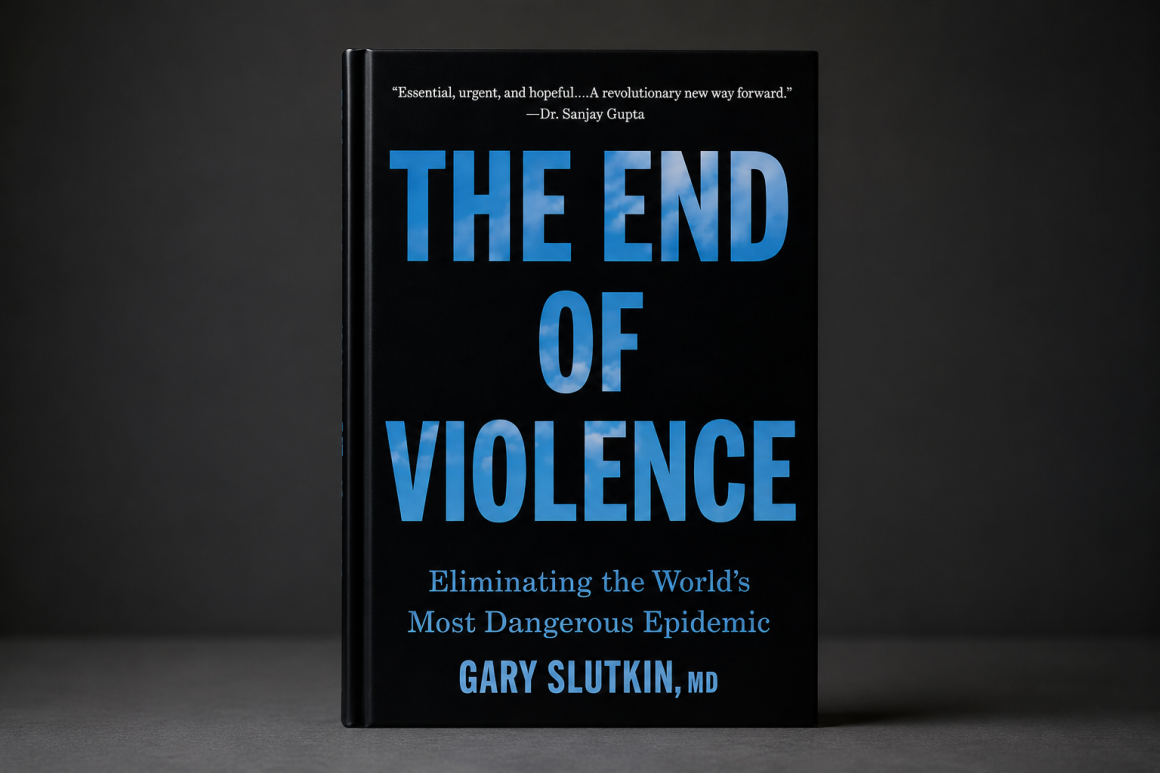

Book review by Kerstin Leitner
We are currently experiencing a series of gruesome wars, and an increasing number of violent attacks on civilians both in war and in non-war situations. It seems a contagious toxin is spreading, and we don’t know how to contain and eliminate it.
Now a book was published with the title “The End of Violence” by Gary Slutkin, a former WHO staff member, that can revolutionise our political thinking and action, not only nationally, but also internationally. It is an unusual political book.
Here writes a physician from Chicago, specialising in epidemiology, who came into contact with the effects of urban violence early on as an emergency physician. In the early 1980s he was also confronted with the HIV/AIDS epidemic, which made medicine and public health in the USA and elsewhere seem powerless. The origin of the disease was not known and therefore no treatment methods were available. In the beginning of the epidemic, public education and empathy with the sick therefore proved to be the most effective antidote. As a WHO staff member, the author fought various epidemics in many countries.
Returning to the USA, Dr. Slutkin devoted himself to researching and treating outbreaks of violence in urban neighbourhoods and founded a civil society organisation for this purpose, applying methods of epidemiology. The results are astounding. Many examples from the USA, African and Asian countries are given to show how effective these methods can be. At the same time, he clears up some common views. For example, he shows that punishment does not work, often it increases violence. The conflicts in the Middle East are proof of this insight. Or: economic development does not reduce the potential for violence in society. This must be addressed separately and as a matter of priority. Both the violence in US and Russian society serve as an example and proof of this thesis.
He also corrects the view that humans are violent from birth. Recent brain research indicates that this generalisation is not true. All humans have both a predisposition to violence to assert our interests and a predisposition to reason. Which predisposition we activate depends on several factors. The bottom line is, we have a choice, and violence is not the only option in any situation.
Nor can it be said that certain places or human communities cause violence. It depends on how much violence we are individually exposed to. However, this threat can be changed, and proven epidemiological measures can help.
According to Slutkin, state violence knows three types, which overlap and are intensified by the massive use of force by the state:
- Violence against the state, i.e., extremism, terrorism. The infection runs through recruitment. Punishment is not a successful countermeasure. Understanding and re-education are more likely to bring success.
- Violence of the state against social groups, e.g., religious communities, ethnic minorities. Politicians often use extremist online methods. This must be interrupted. Religious beliefs are particularly contagious and can be especially virulent. State action requires a sense of proportion and moderation to interrupt this form of epidemic.
- Violence of one state against another, e.g., war and military conquest. The author repeatedly points out that violence can remain dormant for a long time in collective memory. Therefore, this memory must be corrected through historical research so that its effect is weakened. In this context it is important to look at a problem from several perspectives, which increases understanding and opens up pathways towards possible solutions.
Unfortunately, the UN Charter is not mentioned as a script for combating state violence in national and international politics. This is all the more regrettable because the UN Charter can still be regarded as the best way to combat the global epidemic of violence.
Authoritarian leaders often serve as accelerators of the epidemic. Such index cases are isolated in the event of a virus epidemic. How this can be achieved in the political sphere remains open.
In general, the author rightly says that there is still a lot we do not know about how to protect humanity against the global epidemic of violence. But he lists eight measures that can be taken now:
- Public education about the “disease” of violence.
- Active treatment of individual cases, which are then replicated in wider application.
- Disrupting the spread of hatred and portraying instead the real situation truthfully.
- Services with a wide outreach, communication by generally respected persons and institutions.
- Community responses to the threat of violence, social and legal rules as guardrails to limiting violence.
- Changing the political narrative: we don’t need enemies.
- Isolation of violent leaders, action on several levels, courage and perseverance, the use of armed control only as a last resort.
- Providing a way out of a situation that focuses on healing rather than punishment.
Point 8 is particularly noteworthy. Because an exit for politicians from violence is what we urgently need. In addition, we need to improve and generalise our mediation skills. A huge political construction site. But Gary Slutkin gives us many hints and suggestions. We should take these up and pursue them further. Because then the idea that wars are a phenomenon of the past could become a reality.

Dr. Kerstin Leitner served with UNDP for 28 years. Among other functions, she was Resident Coordinator in Malawi and China. After her UNDP service, she was for 2 years Assistant Director-General at WHO, Geneva, in charge of Health and Environment. She retired from this post in 2005 and now lives in Berlin, Germany.