
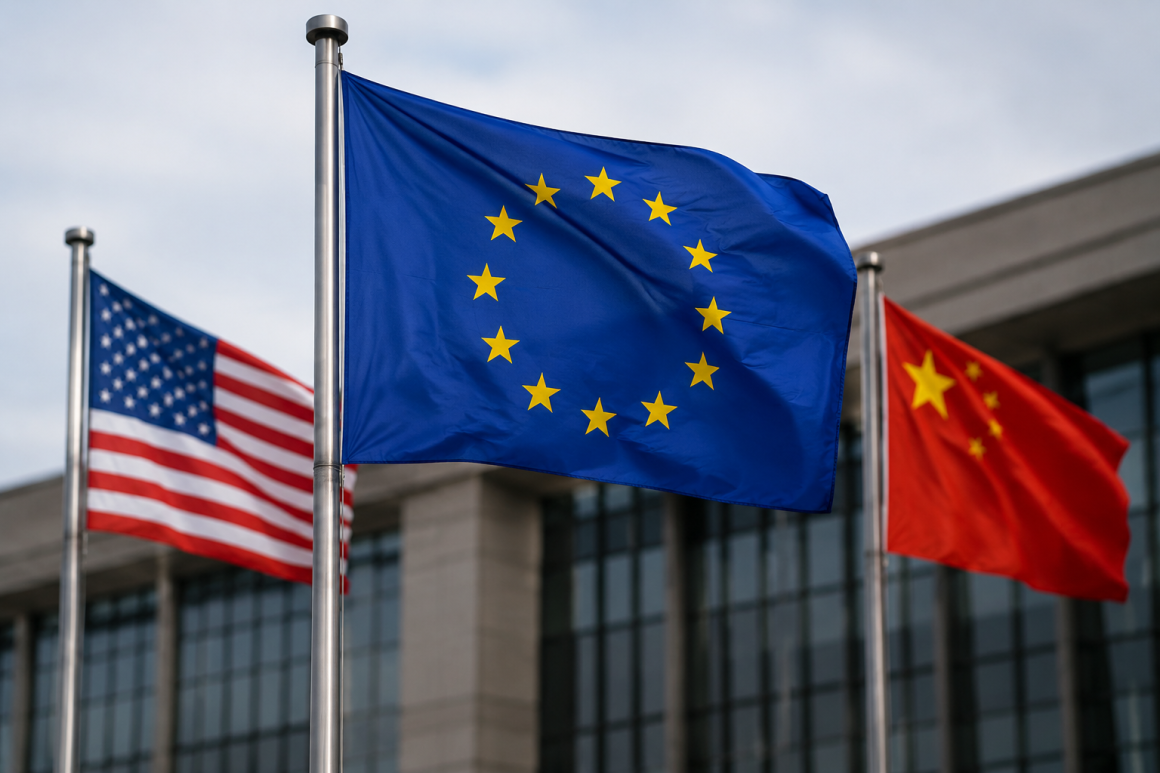


The strategic rivalry between the United States and China is reshaping the post-Cold War international order, with consequences for trade, technology, finance and security. Europe is deeply affected by this competition, but it does not constitute a third equivalent power. The European Union is an economic and regulatory heavyweight, yet it remains less politically and militarily centralised than either Washington or Beijing.
Europe’s challenge is therefore not to remain equidistant from the two. It is to preserve the transatlantic alliance, manage its economic relationship with China and develop the capacity to act when European interests do not fully coincide with those of either partner.
The United States and the Return of Power Politics
The United States continues to combine military power, leadership in frontier technologies and financial influence. In 2025, US military expenditure amounted to an estimated $954 billion, compared with $336 billion for China. The second Trump administration has further reinforced a vision centred on national interest, strategic competition and the preservation of US global leadership through the use of economic instruments as geopolitical tools. Washington now uses tariffs, export controls, restrictions on sensitive technologies and financial sanctions alongside traditional diplomacy.
The dollar gives the United States another source of influence. The currency accounted for 57.13% of global foreign-exchange reserves in the first quarter of 2026. Meanwhile, the growth of dollar-backed stablecoins could extend the currency’s reach in digital finance and further reinforce its position as the world’s primary reserve and transaction currency.
China: A Rising Power Focused on Internal Consolidation
China’s influence has a different origin. Much of it comes from the scale of its industrial base, its infrastructure investments and its role in global trade. In 2025, the EU imported €559.4 billion in goods from China but exported only €199.6 billion, producing a bilateral goods deficit of €359.8 billion. Dependence is even more pronounced in critical inputs: China is the leading refiner for 19 of the 20 strategic minerals examined by the International Energy Agency, with an average market share of around 70%.
Yet its priorities remain largely focused on domestic consolidation rather than on projecting an openly expansionist global agenda. Its population fell by 0.241% in 2025, while the International Monetary Fund projects growth to slow to 4.6% in 2026 amid weak domestic demand due to precautionary savings and prolonged property-sector adjustment. Although China has considerably expanded its international presence through infrastructure investments and strategic partnerships, it has relied more heavily on economic statecraft than on the kind of overseas military presence historically exercised by the United States.
Europe should therefore neither underestimate China’s strategic reach nor interpret every form of Chinese engagement as evidence of an unlimited capacity for expansion.
Europe: Considerable Power, Incomplete Capacity
Europe occupies a unique position within this emerging international landscape. Unlike the United States or China, the European Union was not conceived as a centralised military power. It developed instead as a democratic project founded on political pluralism, the rule of law and multilateral cooperation. Coercive power has not generally been its main source of influence. The EU has relied instead on the rules and standards it helps create and on cooperation through international institutions.
This remains Europe’s greatest strength, but also one of its principal vulnerabilities. Decisions under the Common Foreign and Security Policy generally require unanimity in the Council, allowing national disagreements to delay or dilute collective decisions. European security also remains anchored in transatlantic cooperation, which the Council of the EU describes as a cornerstone of global security. The economic relationship is equally substantial: in 2025, the EU exported €554 billion in goods to the United States and imported €354.4 billion.
The asymmetry matters. Europe’s relationship with the United States is an alliance marked by security interdependence and occasional economic disagreement. Its relationship with China is one of commercial interdependence, industrial competition and exposure to concentrated supply chains. Treating Washington and Beijing as interchangeable threats would therefore be analytically mistaken and politically counterproductive.
Rather than choosing between Washington and Beijing, Europe should strengthen its own strategic autonomy through industrial policy and investments in technological innovation, energy security, defence capabilities and research.
Strategic Autonomy Without Neutrality
Europe’s greatest mistake would be to assume that continued prosperity can rely indefinitely on American security guarantees while maintaining deep economic dependence on external actors. Strategic autonomy should not mean neutrality, protectionism or withdrawal from long-standing alliances. Rather, it should mean possessing the industrial, technological, financial and political capabilities necessary to make independent decisions while remaining an active supporter of an open international order. In relation to China, this is consistent with the EU’s declared policy of “de-risking, not decoupling”: reducing critical vulnerabilities and diversifying supply chains while preserving cooperation where it remains mutually beneficial.
Achieving this goal will require more than declarations. Europe must invest in energy security, defence production, research, digital infrastructure and critical technologies. To do so, it needs deeper capital markets that can direct more of its savings towards innovation within the EU. Europe must also strengthen its payment and monetary infrastructure as digital finance may give dollar-based networks a wider reach. The scale of the task is substantial: the Draghi report estimated that meeting Europe’s strategic objectives would require at least €750–800 billion in additional investment each year, equivalent to 4.4–4.7% of EU GDP in 2023.
As global competition intensifies, Europe does not need to become another superpower modelled on either the United States or China. Its distinctive contribution remains the attempt to combine economic openness, democratic governance and international cooperation. But values carry geopolitical weight only when they are supported by the capacity to defend and implement them.
Europe’s position between Washington and Beijing will become an asset only if it can convert its economic and regulatory influence into strategic capacity. Its place in the new global order will not be secured by equidistance, but by the ability to remain allied without being dependent, open without being vulnerable and cooperative without surrendering the freedom to act.