
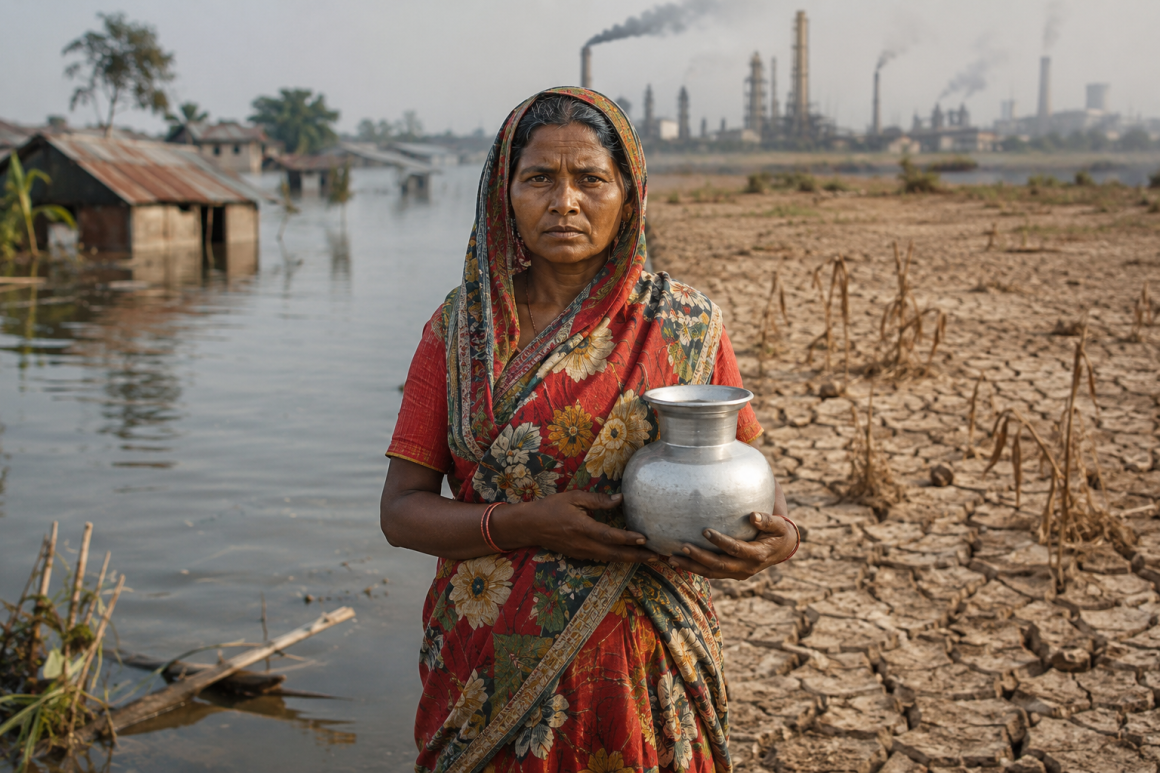

Earth Day 2026 carried the theme “Our Power, Our Planet.” Yet from a Global South feminist perspective, Earth Day cannot remain a symbolic exercise of tree planting, corporate sustainability campaigns, or institutional self-congratulation. It must become a day of reckoning.
The climate crisis is not merely environmental. It is deeply connected to histories of colonial extraction, racial capitalism, militarised development, patriarchy, caste, and the systematic devaluation of care work and Indigenous ecological knowledge. Across South Asia, Sub-Saharan Africa, Latin America, and Small Island Developing States, women, peasants, fisher communities, forest dwellers, and gender-marginalised people face droughts, floods, cyclones, heatwaves, land grabs, debt traps, and forced migration as interconnected forms of climate violence.
The Global South as a Climate Sacrifice Zone
The Global South bears the heaviest burden of climate impacts despite contributing the least to global emissions. According to the Climate Inequality Report 2023, the richest 10 percent of the world’s population generate nearly half of global emissions, while poorer communities face the greatest losses from climate disasters. Climate impacts are felt far more intensely in the Global South than in the Global North.
Floods in Pakistan, droughts across the Horn of Africa, cyclones in Bangladesh, heatwaves in India, and sea-level rise threatening island nations are not isolated disasters. They are connected through colonial histories, global inequality, and political neglect. Climate violence follows structures of power.
Feminist Ecologies and Invisible Labour
Global South feminist perspectives highlight the invisible labour that sustains life during climate crises. Women and gender-diverse communities maintain food systems, protect water sources, preserve seeds, sustain forests, and care for children and elders under worsening ecological stress. Yet this labour remains largely unpaid and unrecognised.
The Global Alliance for Green and Gender Action (GAGGA), a global network supporting women-led environmental justice movements, emphasises that climate change is fundamentally gendered and that women’s rights must be central to climate justice. Similarly, the University of Leeds Climate Hub documents how women across the Global South build ecological resilience through collective stewardship and local knowledge systems.
Ecofeminism argues that the domination of women and the domination of nature emerge from the same patriarchal logic. Climate justice therefore requires structural transformation rather than symbolic inclusion.
Fossil Fuels, Militarism, and Climate Colonialism
The climate crisis cannot be separated from war and fossil fuel power. Fossil fuel extraction is not merely an energy system; it is a geopolitical structure sustained through militarism, displacement, debt dependency, and ecological destruction. According to the University of Washington Global Health Justice Partnership (2023), wealthy nations and corporations have locked many developing countries into fossil fuel dependence through loans, infrastructure projects, and extractive trade systems.
Oil- and gas-rich regions such as the Niger Delta, the Amazon, Sudan, and the Middle East have become zones of environmental devastation and forced migration. Even without formal war, fossil fuel dependency produces food inflation, transport insecurity, and agricultural collapse for poorer countries.
Climate governance itself increasingly reproduces colonial power under the language of sustainability. Carbon markets, offset schemes, debt-linked climate finance, and profit-driven renewable projects often repeat extractive patterns while displacing Indigenous and local communities.
A recent Fairplanet paper 2024 (FairPlanet. (2024). How climate colonialism affects the Global South on climate colonialism defines climate colonialism as the continuation of exploitative North–South relations through environmental policy and offset mechanisms. Countries already suffering climate destruction are often forced to borrow money to survive crises they did not create.
Loss and Damage as Climate Debt
This injustice is especially visible in debates around Loss and Damage finance. For many Global South communities, loss and damage is not charity but climate debt. Countries historically responsible for emissions owe reparative justice for destroyed ecosystems, displaced populations, lost livelihoods, cultural uprooting, and generational trauma.
The South African Institute of International Affairs (SAIIA) argues that loss and damage finance must be fair, accessible, and not donor-driven.
However, reparations must go beyond financial transfers. They must challenge austerity, debt dependency, and extractive economic systems while restoring autonomy, public care systems, and ecological relationships.
Indigenous, Feminist, and Relationship-Centred Futures
Global South feminist and Indigenous movements call for a different future grounded in Indigenous sovereignty over land and water, food sovereignty, decentralised renewable energy, agrarian reform, and recognition of care work as climate infrastructure.
The Feminist Green New Deal Coalition urges leaders to invest in community-led solutions rather than corporate techno-fixes.
Indigenous philosophies such as Pachamama in the Andes, Buen Vivir in Latin America, Ubuntu in Africa, and Gandhian ecological ethics reject the idea that Earth is a commodity. These approaches emphasise reciprocity, interdependence, and relational ethics. Contemporary scholarship on Buen Vivir and Sustainability highlights how decolonial approaches can redefine sustainability beyond extractive growth models.
The Gandhian economist J. C. Kumarappa, in The Economy of Permanence, argued that economies should be built on ecological balance, decentralisation, participation, and responsibility toward life rather than profit and extraction. The Internet Archive edition of The Economy of Permanence demonstrates the continuing relevance of Kumarappa’s ecological thinking.
His relationship-centred understanding of sustainability resonates strongly with feminist and Indigenous perspectives that see sustainability not as technological management of resources, but as rebuilding caring and democratic relationships between people, communities, and nature.
Toward Feminist Climate Justice
A just future requires structural transformation. The fossil fuel era must end through a just transition that redirects military and fossil fuel subsidies toward community-owned energy, food, water, and care systems. Climate debt must be institutionalised through reparations, debt cancellation, and democratic climate finance centred on Indigenous peoples, peasants, fisherfolk, and women’s movements.
Climate governance must become care-centred, and climate knowledge must be decolonised by foregrounding Indigenous, feminist, and anti-colonial ecological thought.
Development itself must be redefined: not as extraction and domination, but as participation, relationship, reciprocity, and care.
Earth Day, if it is to matter, must help build that world.

Sudha Sreenivasa Reddy is Director of the Eco Foundation for Sustainable Alternatives, consultant with the Centre for Child and the Law, National Law School of India University, Bengaluru, India and a former Advisor to FOGGS. Her work spans peacebuilding, climate justice, gender justice, food and nutrition security, and the inclusion of vulnerable persons with disabilities, religious minorities, and sexual minorities, across practice, advocacy, policy, research, and community engagement. Drawing on Gandhian ethics, feminist peace theory, and Global South perspectives, her writing engages conscience, justice, and lived realities. She is a recipient of the Maya Koene International Peace Award (2025).